
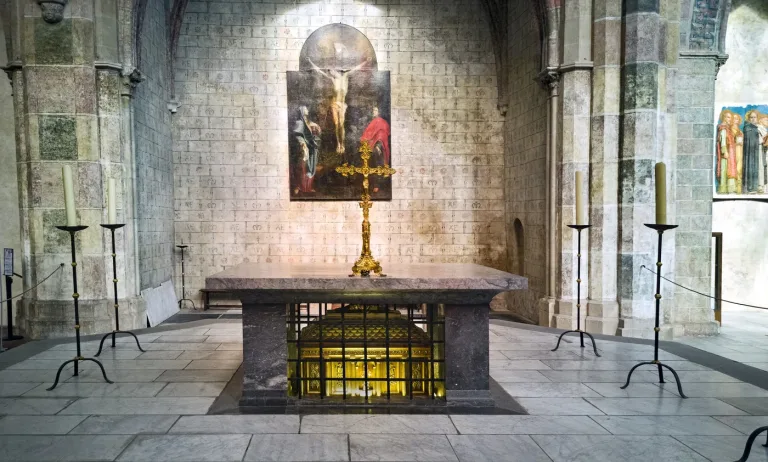
Couvent des Jacobins, Toulouse
Aquinas rests in the historic Jacobins church, a former Dominican convent now cared for as a Toulouse monument.
- Location
- Toulouse, France 43.6039° N · 1.4400° E
- Type
- Historic Dominican church and municipal heritage monument Southern Gothic brick church with a double nave and the twenty-two-rib palm vault
- Dedication
- Historic Dominican church of the Jacobins
At the altar of the Angelic Doctor
Enter the long brick church from central Toulouse and let the twin naves lead toward the altar. Beneath it are the relics of Saint Thomas Aquinas. The church was built for the Dominicans’ prayer, study, and preaching; the height of its palm vault and the quiet of its cloister still make that vocation legible. A pilgrim can come to pray before Thomas and also understand the city that received him after his death.
A Dominican church and a translated tomb
The Jacobins church grew in stages from the thirteenth into the fourteenth century. Its two parallel naves served the friars and the faithful. Aquinas died at Fossanova in 1274. His principal relics came to Toulouse in the fourteenth century, when the Dominican Order made this church a place of veneration for its great theologian. During the French Revolution the shrine was damaged and the relics were sheltered at Saint-Sernin. They returned to the restored Jacobins church in the twentieth century. That history matters: the present altar is the site of custody today, while Saint-Sernin belongs to the translation story. The active Dominican house at Rangueil is another place altogether.
The brick exterior gives little warning of the church’s scale. Inside, a row of columns divides the space into two naves. At the eastern end, twenty-two ribs spread from one column into the vaulted choir, the celebrated palm. Beyond the church, the cloister connects the chapter house, refectory, and Saint-Antonin chapel. These were rooms of a working Dominican community, not an ornamental annex to a tomb.
Spiritual Significance
Pause at Aquinas’s altar before crossing into the convent rooms. His writings served the Church because he trusted that faith and reason belong together. The place holds his memory in stone and in the physical remains entrusted to Toulouse.
Do Not Miss
-
The altar of Saint Thomas Aquinas
The principal relics are preserved here in the historic Jacobins church.
-
The palm vault
Twenty-two ribs spread from a single column above the choir.
-
The cloister
The ticketed rooms show how Dominican study, prayer, and community were joined.
How to Visit
Enter through the church on Allée Maurice Prin. The church is free to visit; the cloister and other convent rooms require a ticket. The municipal custodian publishes current opening times, reservation conditions, and any temporary restrictions. Check those before travel, especially for Thursday group arrangements and events.
Begin in the church; allow time for the cloister.
The custodian lists free access to the church and ticketed access to the adjoining convent rooms. Current hours and group arrangements can change; check the official visit page before going.
- Location
- Allée Maurice Prin, central Toulouse; entrance through the church.
- Access
- Church free; ticket required for the cloister and convent rooms.
Current access
Relics, Tombs, Sacred Objects
Relics and Sacred Tradition
- The historic Jacobins church preserves the principal relics of Saint Thomas Aquinas beneath its altar. The present site is distinct from the active Dominican convent at Rangueil.
Sacred Objects
- The altar and reliquary of Saint Thomas Aquinas
- The Dominican church and cloister
Connected Saints
Map
Sources reviewed 2026-09-30: Jacobins municipal custodian, architecture and visit pages; Ordo Praedicatorum account of the medieval translation, Revolutionary shelter at Saint-Sernin, and twentieth-century return. Image provenance is governed by media-manifest entry church-of-the-jacobins-toulouse-01. Coordinates approximate the physical church, not the Rangueil Dominican house.
September 30, 2026
Photo credits
- Hero. Didier Descouens, CC BY-SA 4.0, via Wikimedia Commons. Source. CC BY-SA 4.0.