
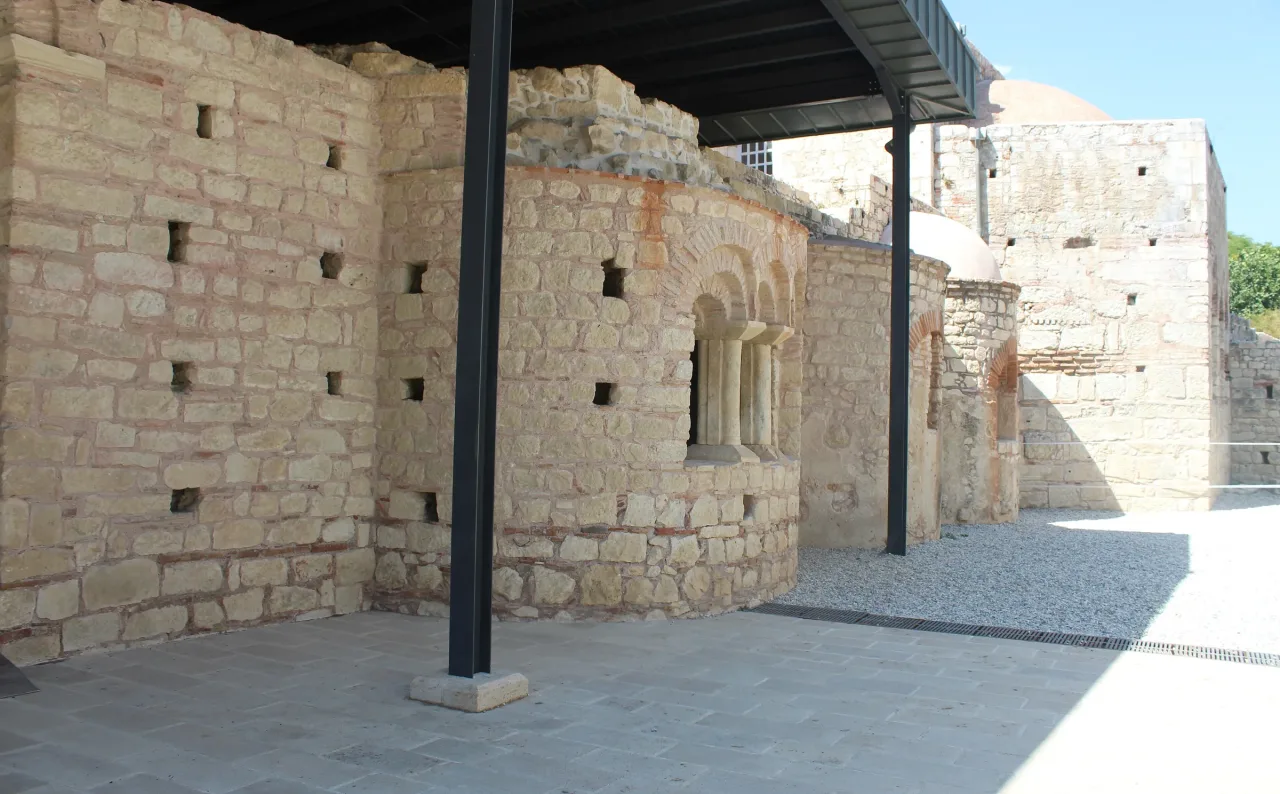
Church of St. Nicholas, Demre
The church complex at Demre, ancient Myra, where Christian tradition places the death and original burial of Nicholas, bishop of Myra.
- Location
- Demre, Turkey 36.2447° N · 29.9854° E
- Type
- Historic church complex and memorial museum A layered church complex, built, rebuilt, repaired, and altered across several periods, with major Middle Byzantine additions and restoration in the eleventh century
- Dedication
- St. Nicholas, bishop of Myra
Nicholas in the city he served
Most people meet Nicholas as a Western figure of Christmas.
Demre offers the older encounter: a bishop in the city he served, and the place where Christian memory of his burial took architectural form. The surviving church is not the church of Nicholas's own lifetime, and the sarcophagus is not proven to be his. But this is where his episcopate and first burial were remembered, before relics venerated as his were carried to Bari.
Myra, then Bari
Nicholas was bishop of Myra in Lycia. Christian tradition places his death and original burial at Myra. Turkish cultural authorities describe a church dedicated to Nicholas at the location of his burial, and they record repeated rebuilding and restoration. What stands today is a layered complex, not an intact fourth-century church. Major Middle Byzantine additions and restoration date to the eleventh century.
A decorated Roman-period sarcophagus in the church is traditionally thought to have been associated with Nicholas. That identification is not certain. The official Turkish museum source also says that bones believed to be Nicholas's are displayed at the Antalya Museum. That is a belief, not a certainty.
In 1087, relics venerated as those of St. Nicholas were removed from Myra and carried to Bari. The Basilica of San Nicola in Bari documents that translation, and the Holy See's canonical documents for that basilica refer to the translation of the relics of St. Nicholas, Bishop of Myra, from Myra to Bari. Myra holds the episcopal life, local veneration, and the first burial memory. Bari holds the later relic shrine and its wide devotion in East and West. Nicholas's chronology is historically uncertain, so no birth or death years are given here. His saint page carries that nuance.
The complex is a layered monument, and it should be read that way. Wall paintings depict Christian scenes and traditions connected with Nicholas. Floor mosaics and opus sectile survive from later Byzantine phases. A decorated sarcophagus of the Roman period is traditionally associated with Nicholas. Excavations north of the church have found monastic and episcopal structures. Everywhere there is evidence of repair, destruction, restoration, and rebuilding.
How to pray at Myra.
Nicholas was a bishop before he was a figure of legend.
A bishop before a legend
Let Nicholas be a bishop before he is a legend. Pray for pastors, and for those who carry the memory of the Church across generations.
East and West
Myra keeps the first burial memory and Bari keeps the later relic shrine. Hold the two together as a bridge between Christian East and West, without claiming an institutional unity between them.
Tradition, held honestly
The sarcophagus is traditionally associated with Nicholas, and that identification is not certain. Venerate the memory, and let the church's many layers teach you how long that memory has been kept.
Spiritual Significance
This place invites you to meet Nicholas as a bishop before he is a figure of legend. The church is a Turkish memorial museum and archaeological monument. It is not an ordinary functioning Catholic parish.
Do Not Miss
-
The decorated sarcophagus
Traditionally associated with Nicholas. The identification is not certain.
-
Wall paintings and floor mosaics
Later Byzantine phases of a church rebuilt many times.
-
The excavated monastic and episcopal structures
North of the church, they belong to the wider complex around the burial memory.
- That this is a layered church complex, not a single-period building.
- Wall paintings depicting Christian scenes and traditions connected with Nicholas.
- Mosaic and opus sectile floors.
- The decorated sarcophagus traditionally associated with Nicholas.
- The evidence of repair, destruction, restoration, and rebuilding.
How to Visit
The church is administered as a Turkish memorial museum. Hours, ticketing, conservation conditions, and access change seasonally, so consult the live Turkish museum listing before you go.
Continue Your Pilgrimage

Map
Republic of Türkiye museum and culture authorities; Basilica di San Nicola, Bari, on the translation of the relics.
September 18, 2026
Photo credits
- Hero. Interfase / Wikimedia Commons (CC BY-SA 4.0). Source. CC BY-SA 4.0. Cropped from the original.