
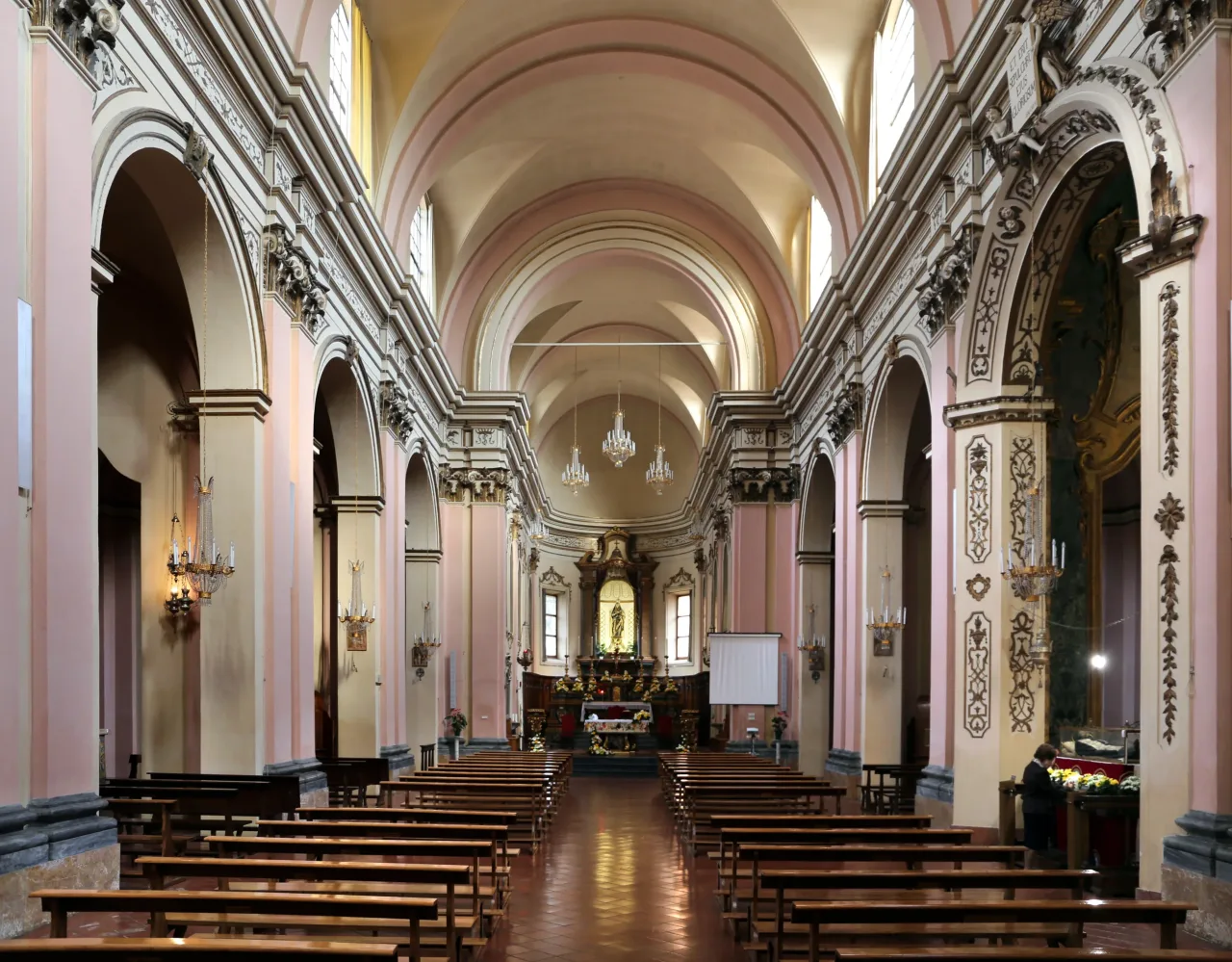
Basilica of San Pellegrino Laziosi
A working Servite church in the middle of Forlì, where the body of Saint Peregrine Laziosi lies in an urn and where people bring cancer to prayer every Wednesday.
- Location
- Forlì, Italy 44.2199° N · 12.0419° E
- Type
- Catholic minor basilica, sanctuary and parish church of the Servite Order A medieval Servite church behind a plain brick front, with a pointed thirteenth-century portal, and an interior remade in the seventeenth and eighteenth centuries
- Dedication
- Santa Maria dei Servi, the Servite church of Forlì, known since the eighteenth century by the name of Saint Peregrine Laziosi
- Time Needed
- 30 minutes to 2 hours
The church people come to with a diagnosis
Come because this is where the devotion actually lives. Saint Peregrine is invoked all over the world by Catholics facing cancer, and almost none of them can reach the one place where his body is. It is not a monument. It is a parish with a shrine inside it, open morning and late afternoon, with a named weekly prayer for people carrying a tumor. Two points inside the building carry the story: the chapel where his body is preserved, and the chapter room where he is said to have prayed the night before the surgeons were to take his leg.
One church, two places
The Servants of Mary were established at Forlì in the thirteenth century, before Peregrine returned to the city as a friar, and their church of Santa Maria dei Servi is the building that stands here now. He lived, preached and heard confessions in this community, and died here in about 1345. His body was placed in an urn in the chapel on the right of the nave in 1723, three years before Benedict XIII canonized him. The chapel was rebuilt and enlarged more than once, and took its present eighteenth-century form under the architect Giuseppe Merenda. The other place is quieter and easier to walk past. At the end of the nave is the chapter room, where a painted Crucifixion of the fourteenth century, attributed to Giuliano da Rimini, still hangs. Tradition places Peregrine's night of prayer before that image, and the church has kept it ever since.
The front is plain brick, and the pointed portal with its twisted stone colonnettes is the oldest thing a visitor sees. Inside, the medieval church has been almost entirely remade: a broad three-aisled interior in pink and white, barrel-vaulted, refitted in the seventeenth and eighteenth centuries. The Chapel of San Pellegrino belongs to that later work, all polychrome marble and gilt around the urn. The chapter room is the exception, and holds what the rest of the building lost.
The tomb is not the whole story. Find the other room.
Most visitors reach the chapel, pray, and leave. The building holds two things, and they mean different things.
Stand at the urn without deciding what it proves
His body is preserved in an urn in the chapel. No diocesan, Servite or basilica source describes it as incorrupt. It is enough that he is here.
Go and find the chapter room
The Crucifixion attributed to Giuliano da Rimini is the physical survival at the center of the devotion. Whatever happened that night, this is the image the tradition names, and it is still in the room.
Come on a Wednesday if you can
At 17:00 the community prays for people with tumors. It is the plainest answer this church gives to the question people arrive with.
The tomb and the place associated with the healing are two distinct points inside one building.
Paul VI raised the sanctuary to the rank of minor basilica in 1977.
The church has been served by Servite friars from the Philippines since 2009, where devotion to Saint Peregrine is strong.
A Servite jubilee year for the third centenary of his canonization runs from May 1, 2026 to May 4, 2027.
Two places matter inside one church: the chapel where his body lies, and the room where he prayed the night before the surgeons were to take his leg.
This is a church for people who are frightened. The devotion here is not built on a promise of cure; it is built on a friar who was told he would lose his leg and spent the night in front of a crucifix. What the community offers is prayer alongside people in treatment, week after week, which is a different thing from a guarantee and a more durable one.
Do Not Miss
-
The urn in the Chapel of San Pellegrino
Third chapel on the right, under Cantarini's canvas of Christ reaching down to the saint's leg.
-
The chapter room and its Crucifixion
The fourteenth-century painted Crucifixion the healing tradition names, with Livio Agresti's scenes from Peregrine's life.
-
The Wednesday prayer at 17:00
The weekly prayer for those with tumors, and the clearest sign that this is a living shrine.
-
The medieval portal
The pointed thirteenth-century doorway, the one part of the original church still in plain view.
- How ordinary the church is: a working parish that happens to hold a shrine
- The distance between the chapel and the chapter room, and how easily the second is missed
- Votive offerings and written intentions left by people in treatment
Visit Plans
-
The urn, then the chapter room
4 ordered stopsPray at the urn in the third chapel on the right, then walk to the end of the nave for the chapter room and the Crucifixion the tradition names.
- The Chapel of San Pellegrino and the urn
- Cantarini's altarpiece above it
- The chapter room and its painted Crucifixion
- Time to pray for someone by name
-
Arrive for the late afternoon and stay for the prayer
4 ordered stopsTake an afternoon train from Bologna, reach the church after it reopens at 16:30, see the chapel and the chapter room unhurried, and stay for the 17:00 prayer for those with tumors.
- Arrival after the afternoon opening
- The chapel and the urn
- The chapter room
- The Wednesday prayer for those with tumors
How to Visit
The church keeps ordinary parish hours, closed over the middle of the day. Go in the morning or the late afternoon, pray at the urn in the third chapel on the right, and then look for the chapter room at the end of the nave. If you can come on a Wednesday, the 17:00 prayer for those with tumors is the reason the shrine still means what it means. On May 1 the feast fills the whole day and the church is busy from early morning.
- Daily Mass and the ordinary parish life of a Servite community
- Prayer for those with tumors and other serious illness, every Wednesday at 17:00
- The feast of Saint Peregrine on May 1, kept through the day with repeated Masses
- Current worship times should be confirmed with the community before travel
Ordinary parish hours, with a long midday closure.
This is a working church, not a museum. It closes over the middle of the day, and liturgy takes priority over visiting. The community publishes a phone number; use it before you build a day around the visit.
- Address
- Via Giuseppe Mercuriali 1, 47121 Forlì (FC), on Piazza Morgagni
- Published hours
- Daily, 07:30 to 11:30 and 16:30 to 18:45. Confirm before you travel.
- Telephone
- +39 0543 34245, or the community mobile 351 7360778
- Time needed
- About 45 minutes for the chapel and the chapter room
- Getting there
- Forlì is 35 to 45 minutes by train from Bologna, and the church is a short walk from Piazza Saffi
Before setting out
- Telephone the community rather than assuming the published window.
- Ask on arrival rather than planning the visit around it.
Two dated things worth knowing
- Programs and crowds during the jubilee are published locally rather than centrally.
- A quiet visit is not possible on May 1. Come the day before or the week after.
Relics, Tombs, Sacred Objects
Tomb and Burial
- Saint Peregrine Laziosi, whose body is preserved in an urn in the Chapel of San Pellegrino.
Relics and Sacred Tradition
- The body of Saint Peregrine, placed in the chapel in 1723, three years before his canonization.
Sacred Objects
- The urn in the Chapel of San Pellegrino, the third chapel on the right
- The fourteenth-century painted Crucifixion attributed to Giuliano da Rimini, in the chapter room
- Simone Cantarini's altarpiece, after a design by Guido Reni, of Christ crucified healing Peregrine's leg
- Livio Agresti's scenes from the life of Saint Peregrine in the chapter room
Map
One record covers both the Chapel of San Pellegrino, with the urn holding the saint's body, and the chapter room with the fourteenth-century painted Crucifixion. The record follows the Diocese of Forlì-Bertinoro and the Comune di Forlì rather than English-language devotional sources, which are unreliable on this church. It does not describe the body as incorrupt, does not date the chapel to a single building campaign, and does not publish confession, accessibility or photography information that no authoritative source states. A formal recognition of the body and a total-body CT scan took place in April 2026; the results were described as undergoing validation and are not summarized here.
September 9, 2026
Photo credits
- Hero. Sailko, CC BY-SA 4.0, via Wikimedia Commons. Source. CC BY-SA 4.0.
- The chapel and the urn. Sailko, CC BY-SA 4.0, via Wikimedia Commons. Source. CC BY-SA 4.0.
- The Crucifixion in the chapter room. Sailko, CC BY-SA 4.0, via Wikimedia Commons. Source. CC BY-SA 4.0.
- The medieval portal. Gloriascaioli, CC BY-SA 4.0, via Wikimedia Commons. Source. CC BY-SA 4.0.