The baptismal font of Saint Thérèse
Sacramental furnishingPublic prayer in the baptistery chapel
Sanctuary of Louis and Zélie, AlençonNotre-Dame is the old parish church of central Alençon: a flamboyant Gothic nave of the later fifteenth and early sixteenth centuries behind one of the finest carved porches in Normandy, with a choir rebuilt in the eighteenth century after fire. Pope Benedict XVI raised it to a minor basilica in 2009. Louis and Zélie Martin were married here at midnight on July 13, 1858, and their youngest daughter was baptized here in January 1873.
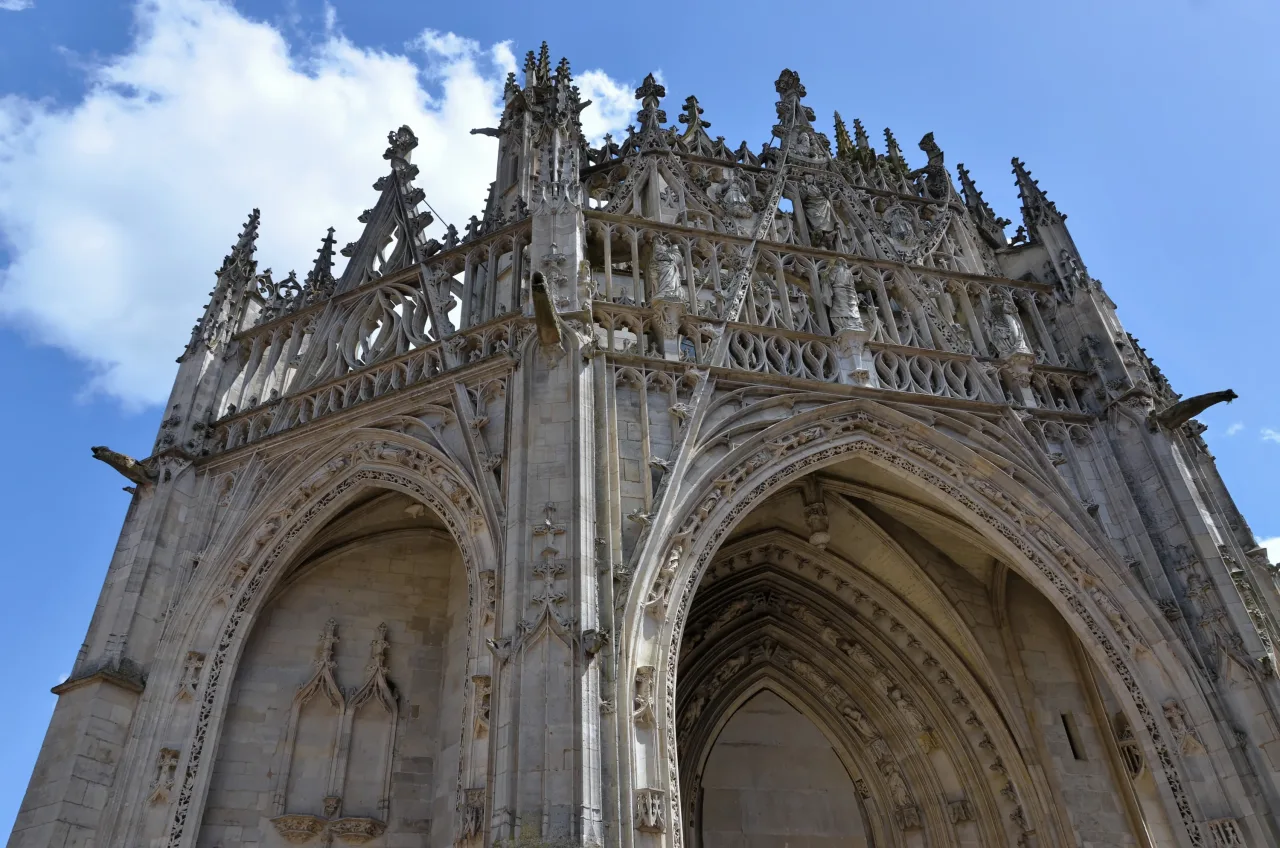
The porch alone would justify the stop: three sides of late Gothic stone carved into something closer to lace than masonry, which is a proper joke in a town that made lace.
But the reason to come is what happened inside it. Two people who had each been turned away from religious life were married here at midnight in 1858, and fifteen years later the last of their nine children was carried to the font in the north chapel. Between those two dates the same building took the funerals of four of their children and, in 1877, of their mother. Most churches show you a saint at the end of a life. This one shows you the sacraments an ordinary Catholic household actually used, in the order a household uses them.
A church has stood on this site since the fourteenth century, and the sanctuary dates the present building from 1470. The nave and its aisles went up in the flamboyant manner of the later fifteenth century, and the great porch was carved in the decades either side of 1500. Fire destroyed the choir, the transepts and the tower in 1744; they were rebuilt between 1745 and 1762 in the classical taste of that moment, which is why the eastern half of the interior does not match the western. The church served the parish through the Revolution and the nineteenth century, and it was the Martins' church from 1871, when they moved into rue Saint-Blaise, until Louis left Alençon in 1877. Their marriage in 1858 was celebrated here, before the move, at midnight on July 13. Pope Benedict XVI conferred the title of minor basilica in 2009, seven years before the couple married here were canonized in Rome.
Flamboyant Gothic outside and in the nave; classical in the choir, the transepts and the crossing. The three-sided porch is the set piece, an openwork screen of gables, tracery and figures.
This is a working parish church with a pilgrimage attached, and it feels like one. It is quieter than the house on rue Saint-Blaise and it has no reliquary to queue for. What it offers is the ordinary business of Catholic life in one building: Sunday Mass, a font, confessions on Saturday afternoon.
A three-sided flamboyant porch carved in the decades around 1500, all crockets, openwork tracery and figures, with the Transfiguration as its subject. It is the reason the building matters as architecture and not only as biography.
Where Thérèse Martin was baptized on January 4, 1873, two days after her birth. A modern window shows the baptism, the walls carry thanksgiving plaques, and a mosaic inscription asks Saint Thérèse to pray for those who come.
Five bays of flamboyant Gothic with sixteenth-century glass in the aisle windows. The Martins were in these seats every Sunday of their married life in Alençon.
The choir, the transepts and the tower were destroyed by fire in 1744 and rebuilt over the following two decades in a classical manner. The join is plain once you look for it, and it is honest to see it.
Louis and Zélie are not buried here and their principal relics are not here. They were buried at Lisieux and their reliquaries are venerated in the crypt of the basilica there. What Alençon holds is the place where their marriage and their children's baptisms actually happened.
The visit almost everyone makes: the carved porch outside, the flamboyant nave, and the chapel where Thérèse was baptized.
The same church read as the sacramental center of one household: where the marriage was made, where the youngest child was baptized, and where the mother's funeral was sung.
It stands on the Place de la Magdeleine in the middle of the old town, about eight minutes downhill from the Martin house and fifteen from the station. Free, open through the day.
Visiting
Prayer and liturgy
Access
Confessions are heard on Saturday afternoon.
The memorial of Saints Louis and Zélie Martin falls on July 12, the anniversary of their wedding here. The sanctuary keeps it with a fuller schedule.
Public prayer in the baptistery chapel
Sanctuary of Louis and Zélie, AlençonNot applicable
Published architectural history of the basilicaNot applicable
Published architectural history of the basilicaSource note Traditional attributions are presented as tradition, with documentation named where it exists.
Three canonized saints of one family are bound to this building by the sacraments they received in it.
Where this church sits within the wider Catholic geography of Alençon.
The house at 50 rue Saint-Blaise, where the family lived from 1871, where Thérèse was born and where Zélie died.
The bridge where Louis and Zélie met in the spring of 1858, three months before they were married in this church.
Written from the Sanctuary of Louis and Zélie at Alençon for the Martin-family history and current liturgical use, with architectural phasing checked against the building's own published history. The sanctuary dates the present church from 1470; the fabric is later medieval and early modern, and the choir, transepts and tower were rebuilt in the eighteenth century after the fire of 1744, so the page names the phases rather than giving one date. The basilica title was conferred in 2009; published accounts differ on the month, so only the year is stated.
August 30, 2026
Use this for corrections, broken links, missing places, and planning ideas.