
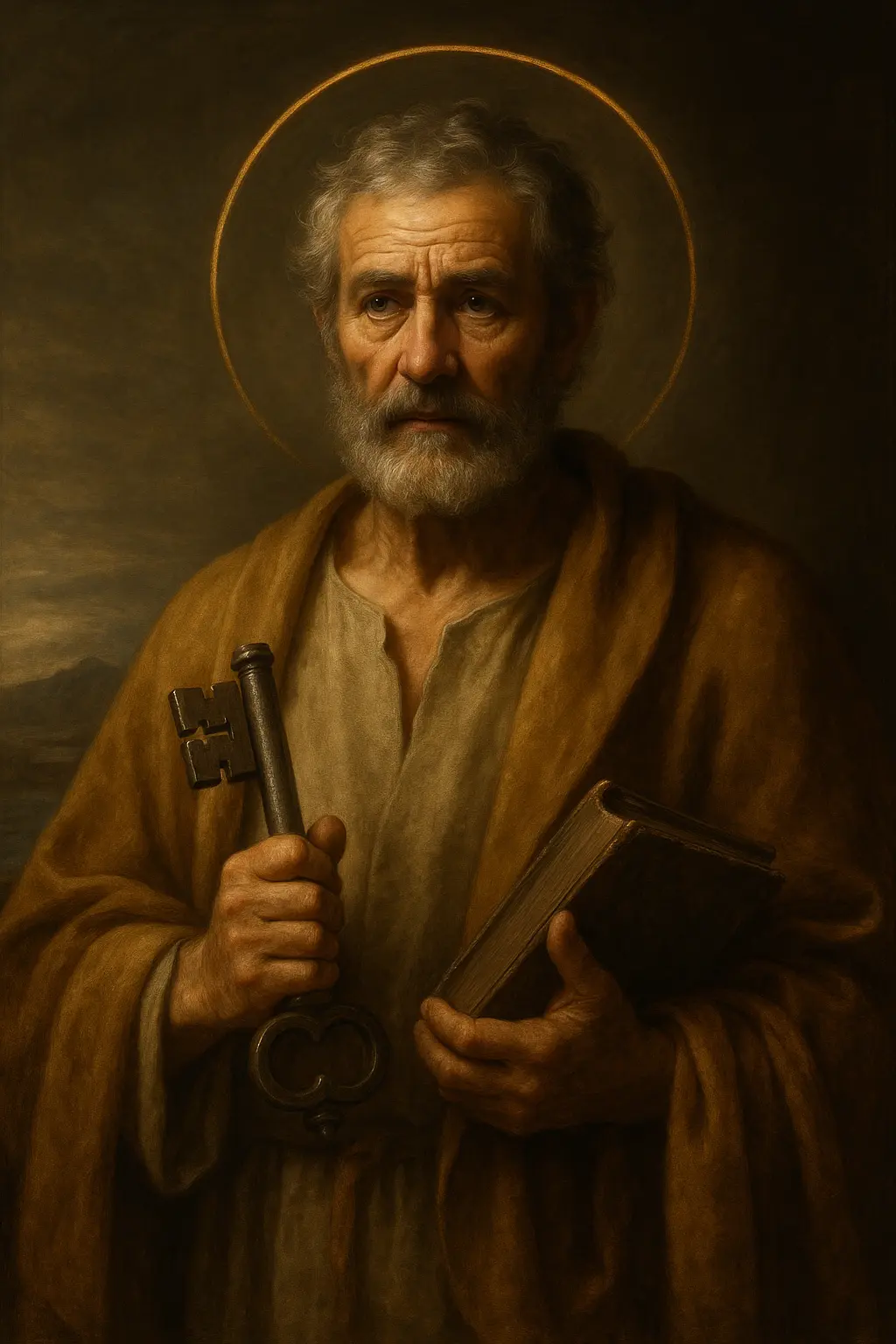
St. Clement I
One of the first successors of Peter, whose letter to Corinth is among the earliest voices of the Church after the apostles.
Love covers a multitude of sins. Love bears all things, is long-suffering in all things.
Clement of Rome, First Letter to the Corinthians (1 Clement 49), c. AD 96 Well-attested
Early Bishop of Rome, author of the letter to Corinth, named in the Roman Canon
Clement was Bishop of Rome at the end of the first century, the third to hold that office after Saint Peter according to the early lists. He is remembered above all for a single document: a letter sent from the church of Rome to the church of Corinth, urging peace and order, written while some who had known the apostles were still alive. It is one of the earliest Christian writings outside the New Testament, and it gives Clement a place near the very beginning of the Church's memory of itself.
Little can be said of Clement's life with certainty. Irenaeus of Lyon, writing late in the second century, places him third in the line of bishops of Rome after the apostles Peter and Paul, and notes that he had seen the apostles and conversed with them. Later tradition identifies him with the Clement named by Saint Paul among his fellow workers in the Letter to the Philippians, though this cannot be confirmed.
What survives is his letter. Around the year 96, a serious dispute had broken out in Corinth, where the congregation had deposed its presbyters. The church of Rome wrote to intervene, calling for repentance, humility, and the restoration of those unjustly removed. The letter, known as First Clement, was read aloud in churches for generations and was at times counted almost as Scripture. It is the earliest clear instance of the Roman church speaking with authority into the life of another, and a witness to the order, succession, and peace that Clement urged.
According to a later and largely legendary tradition, Clement was exiled under the emperor Trajan to the quarries of the Crimea, where he continued to preach, and was martyred by being cast into the sea tied to an anchor. The anchor became his emblem. These accounts come long after his death and are held by the Church as devotion rather than documented history.
In the ninth century, Saints Cyril and Methodius, the apostles of the Slavs, recovered relics venerated as Clement's near the Crimean coast and carried them to Rome. They were placed in the ancient basilica on the Caelian Hill that bears his name, San Clemente, where they are venerated still, and where Cyril himself was later buried.
Clement stands among the Apostolic Fathers, the first generation of Christian writers after the New Testament. His letter to Corinth remains a foundational witness to the early Church's sense of order, succession, and peace, and his name is spoken in the Roman Canon of the Mass, among the early popes remembered at every traditional Eucharist.
A life, in years and approximate ages.
-
Mid-1st century AD1st centuryAmong the First Roman ChristiansClement belongs to the first generation of Christians in Rome. Irenaeus records that he had seen the apostles; later tradition identifies him with the Clement named by Saint Paul as a fellow worker.
-
c. 88 ADAs Bishop of RomeBishop of RomeClement becomes Bishop of Rome, third in the succession after Peter according to the early lists of Irenaeus and others. The dates of his episcopate are known only approximately.
-
c. 96 ADc. AD 96The Letter to the CorinthiansIn the name of the Roman church, Clement writes to Corinth, where the presbyters have been deposed, calling for repentance, humility, and the restoration of order. First Clement becomes one of the earliest and most read Christian writings after the apostles.
-
c. 99 ADMartyrdomExile and MartyrdomAccording to a later and largely legendary tradition, Clement is exiled to the Crimea under Trajan and martyred by being cast into the sea tied to an anchor, which becomes his emblem. The account is held as devotion, not documented history.
-
868Relics translatedRelics Brought to RomeSaints Cyril and Methodius recover relics venerated as Clement's near the Crimean coast and bring them to Rome, where they are placed in the Basilica of San Clemente. Cyril is later buried in the same church.
Dates are approximate where the surviving record is traditional or incomplete.
2 places where this witness remains visible.
Basilica di San Clemente
Pray before the relics venerated as Clement's, then descend through the layers of the church to the Rome he would have known.
The Excavations of San Clemente
The fourth-century church and the first-century Roman streets and sanctuary below, a vertical section through Christian Rome.
Where the body is venerated.
The relics venerated as Saint Clement's rest beneath the high altar of the Basilica of San Clemente, near the Colosseum, where tradition holds they were placed after Saints Cyril and Methodius brought them from the Crimea in the ninth century. The basilica identifies them as his; their full history before the ninth century cannot be documented.
A principal relic site is named, with other fragments or reliquaries noted separately.
Basilica di San Clemente, Rome
The basilica on the Caelian Hill, near the Colosseum, holds the relics venerated as Clement's beneath the high altar. It descends through three levels: a twelfth-century church, a fourth-century basilica below it, and first-century Roman buildings beneath that.
- Relics traditionally venerated as those of Saint Clement, beneath the high altar
- The tomb of Saint Cyril, who brought the relics to Rome
- The three archaeological levels, descending to the Rome of the first century
Allow time for the excavations below the church, which are among the most evocative in Rome. The lower levels keep separate hours and a small admission.
Kindred witnesses
Clement I's Route · 2 stops.
Receive the route as a sequence of prayer and attention, not a checklist to finish in a rush.
-
01 RELIC SITE
Basilica di San Clemente
Rome, near the ColosseumPray before the relics venerated as Clement's, then descend through the layers of the church to the Rome he would have known.
-
02 MEMORIAL
The Excavations of San Clemente
Beneath the basilicaThe fourth-century church and the first-century Roman streets and sanctuary below, a vertical section through Christian Rome.
Kept on November 23.
November 23 is the feast of Saint Clement I, kept across the Latin Church. He is venerated as an early pope and martyr, and as a patron of mariners and others who work on the water, from the tradition of the anchor and the sea.
The Basilica of San Clemente, near the Colosseum, holds the relics venerated as his beneath the high altar. Its three levels descend from a twelfth-century church to a fourth-century basilica and, below that, to first-century Roman streets, a vertical history of the city Clement knew.