
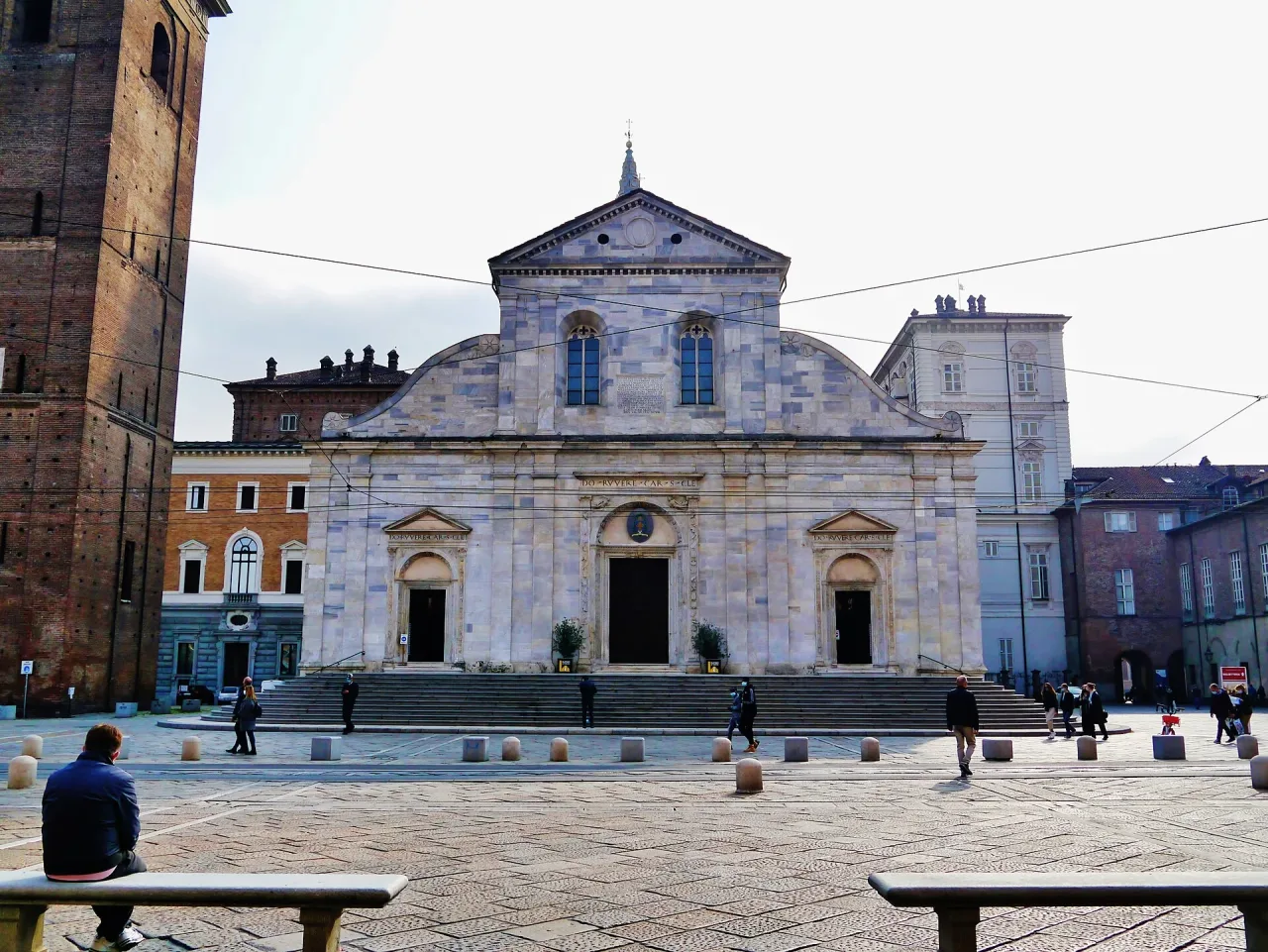
Turin Cathedral
The cathedral of Turin keeps the Shroud in a sealed case beneath the royal tribune. Pilgrims can pray before it any day the cathedral is open; the cloth itself is shown only at rare public expositions.
- Location
- Turin, Italy 45.0733° N · 7.6854° E
- Type
- Cathedral of the Archdiocese of Turin Renaissance Latin-cross church of 1491 to 1498, with Guarini's Chapel of the Holy Shroud behind the choir
- Dedication
- Saint John the Baptist The Shroud, in the last chapel of the left aisle
Praying before the Shroud
Turin's cathedral is a plain Renaissance church with one of the most studied objects in the world at the end of its left aisle.
The Shroud lies there in a conservation case inside a larger metal box, beneath the royal tribune, and it is taken out only for public expositions. On an ordinary day a pilgrim finds a window, a row of benches and kneelers, and the box directly in front of them. No booking is needed.
Nearer the door, in the third chapel on the same side, is the tomb of Saint Pier Giorgio Frassati, the Turin student who climbed mountains, gave what he had to the poor and died at twenty-four. He was canonized in 2025, and many come to the cathedral for him.
How the Shroud came to Turin
The cathedral was built between 1491 and 1498 for Bishop Domenico della Rovere, on the site of three early Christian churches, and dedicated to Saint John the Baptist. Its brick bell tower is older, finished around 1470 and raised by Filippo Juvarra in 1720.
The Shroud's documented history begins in the 1350s at Lirey, in Champagne, where the knight Geoffroy de Charny placed it in the church he had built. It passed to the House of Savoy in 1453 and was kept at Chambéry, where a fire in 1532 burned the holes still visible along its folds; the Poor Clares mended it. In 1578 Duke Emanuel Philibert brought it to Turin, his new capital, and Saint Charles Borromeo came on foot from Milan to venerate it. It has stayed here since.
To house it, the end of the choir was opened for Guarino Guarini's chapel, completed in 1690, and from 1694 the Shroud lay in the urn of its central altar. On the night of April 11, 1997, fire took Guarini's dome. The Shroud was by then in a glass reliquary behind the cathedral's high altar, and firefighters broke the bulletproof glass with a sledgehammer to carry it out. The chapel reopened in 2018. Since 1983, by the will of the last King of Italy, the Shroud has belonged to the Holy See, and the Archbishop of Turin is its custodian.
A stairway climbs from Piazza San Giovanni to a white marble facade with three doors. Inside is a Latin cross: a wide nave between columns of Susa stone, with thirteen chapels along the aisles, six on the right and seven on the left. The first on the left is the baptistery; the third holds Saint Pier Giorgio Frassati.
At the end of the left aisle, beneath the royal tribune, is the chapel of the Shroud, seen through a window. Behind and above the high altar rises Guarini's Chapel of the Holy Shroud, its dome a stack of interlocking arches. It is not entered from the cathedral but from the Royal Palace, on the Musei Reali route.
Spiritual Significance
The Gospels call the cloth Joseph of Arimathea bought to wrap the body of Jesus a sindon, a linen sheet (Mark 15:46). That word is still the Italian name for this one, la Sindone. The image on it is of a man scourged, crowned with thorns and crucified, and the prayer before it is prayer before the Passion.
The Church has never declared it authentic. When Saint John Paul II prayed here in 1998, he said that "since it is not a matter of faith," the Church entrusts the historical and scientific questions to research. Radiocarbon tests in 1988 dated the linen to the Middle Ages, and those results and the formation of the image are still argued over. "For the believer," he said, "what counts above all is that the Shroud is a mirror of the Gospel."
Do Not Miss
-
The chapel of the Shroud
At the end of the left aisle, beneath the royal tribune: benches and kneelers before the case that holds the cloth.
-
The tomb of Saint Pier Giorgio Frassati
In the Trinity chapel, the third on the left. He was beatified in 1990 and canonized in 2025.
-
Guarini's Chapel of the Holy Shroud
Reached through the Royal Palace on the Musei Reali route. The Shroud lay in the urn of its central altar from 1694 to 1993.
-
The Crispin and Crispinian altar
The second chapel on the right, with paintings by Defendente Ferrari.
How to Visit
No booking is needed to pray before the Shroud. Walk to the last chapel of the left aisle during the cathedral's opening hours, which the diocese lists as Monday to Friday 10:00 AM to 12:30 PM and 4:00 to 7:00 PM, Saturday 9:00 AM to 1:00 PM and 3:00 to 7:00 PM, and Sunday 8:00 AM to 1:00 PM and 3:00 to 7:00 PM. Frassati's tomb is in the third chapel on the same side.
Guarini's chapel is part of the Musei Reali, entered through the Royal Palace on a museum ticket. The diocesan museum of sacred art is in the lower church.
Prayer before the Shroud needs no booking.
The Shroud stays in its sealed case except during public expositions, and none is currently announced. On any ordinary day you can pray before the case, free and without a reservation, while the cathedral is open.
- The Shroud
- In a sealed case; shown only at public expositions
- Prayer
- Free, no booking, last chapel of the left aisle
- Weekdays
- 10:00 AM to 12:30 PM, 4:00 to 7:00 PM
- Weekends
- Sat 9:00 AM to 1:00 PM, 3:00 to 7:00 PM; Sun 8:00 AM to 1:00 PM, 3:00 to 7:00 PM
Praying before the Shroud
- The cloth is in a conservation case enclosed in a larger metal box, and cannot be seen directly outside an exposition.
Also here
Relics, Tombs, Sacred Objects
Relics and Sacred Tradition
- The Shroud, the linen cloth venerated as the burial sheet of Christ, kept in a sealed conservation case in the last chapel of the left aisle and brought out only for public expositions
- The body of Saint Pier Giorgio Frassati, in the third chapel of the left aisle
Map
History and visiting arrangements follow the Diocesan Commission for the Shroud and the Musei Reali.
October 26, 2026
Photo credits
- Hero. Photo: Zairon, CC BY-SA 4.0, via Wikimedia Commons. Source. CC BY-SA 4.0.
- The Chapel of the Holy Shroud. Photo: Marie-Lan Taÿ Pamart, CC BY 4.0, via Wikimedia Commons. Source. CC BY 4.0.