Continuous parish life since 1565
Living parishCome to Mass or confession before reading the building. The parish is the older thing.
Cathedral Parish of St. AugustineThe cathedral is best understood as a parish that has never stopped, housed in the fourth or fifth building it has needed, under the patronage of a saint who never saw Florida.
This is a working cathedral parish in a city full of tour groups, and the difference matters. People are baptized here, married here, absolved here, and buried from here. Mass is offered every morning. Confession is heard on Saturday. If you arrive as a pilgrim rather than a sightseer, begin by sitting down and praying, and let the building explain itself afterward.
What is genuinely old here is not the masonry. It is the parish. Catholic sacramental life began in this settlement in 1565 and has continued through fire, siege, a twenty-year British occupation, and the long rebuilding that followed. The present church was begun in 1793, badly burned in 1887, and rebuilt larger. The community that worships in it is older than any wall of it, and that is the thing worth venerating.
Pedro Menéndez de Avilés sighted the Florida coast on August 28, 1565, the feast of Saint Augustine of Hippo, and named the settlement for the saint. He came ashore on September 8, the feast of the Nativity of the Blessed Virgin Mary. Father Francisco López de Mendoza Grajales, chaplain of the expedition, presented the cross for Menéndez to kiss, the Te Deum was sung, and Mass followed. That site is now kept as Mission Nombre de Dios, and the parish that began there is the parish that worships in this cathedral.
The church itself has been destroyed more than once. Francis Drake burned the town and its church in 1586. Carolina forces burned it again in 1702, after which Mass was celebrated in the chapel of La Soledad Hospital. When Florida passed to Britain in 1763 the Spanish Catholic population left almost entirely, and the faith returned through the Minorcan, Italian, and Greek families who came north from New Smyrna in 1777 under Father Pedro Camps. The Spanish crown ordered a new parish church in 1786; its cornerstone was laid in 1793. On March 11, 1870 the Diocese of St. Augustine was created under Bishop Augustin Vérot and the parish church became a cathedral. A fire on April 12, 1887 gutted it again, and Bishop John Moore rebuilt it with transepts and the bell tower that now defines it.
The core of the church is a Spanish colonial parish building of the 1790s: a plain rectangular volume, thick walls, and a bell wall at the front. The nineteenth-century rebuilding after the 1887 fire added the transepts that gave it a cross plan and raised the campanile that now carries the bells. The interior was renovated in the 1960s to serve the liturgical reform of the Second Vatican Council, which is when the Blessed Sacrament Chapel was added and the renovated church was dedicated on March 9, 1966. Read the nave toward the reredos and altar, and notice that the painted timber ceiling, the murals, and the organ are all arranged to bring the eye to the same place the liturgy brings it.
Parish life begun in 1565 at the landing site now kept as Mission Nombre de Dios
Cornerstone of the present church laid in 1793
Raised to cathedral status when the Diocese of St. Augustine was created on March 11, 1870
Rebuilt and enlarged with transepts and a bell tower after the fire of April 12, 1887
Renovated church dedicated on March 9, 1966
Raised to minor basilica by Pope Paul VI on December 4, 1976
The patronage here is real but it is patronal, not biographical. Saint Augustine of Hippo is patron of this parish, this city, and this diocese because the expedition sighted land on his feast. He never crossed the Atlantic, and no relic tradition or life site connects him to Florida. What the parish has instead is a long habit of naming itself after his restlessness, and an annual Augustinian Address on his feast day, August 28. Pray here for the conversion of a divided heart and you are praying in the register the patron actually offers.
Receive the cathedral first as a parish, not as a monument.
Ceiling, murals, and organ are all ordered to the altar.
Added in the 1960s renovation for quiet Eucharistic prayer.
The crossed keys and tiara record the 1976 papal grant.
Mass or quiet prayer, the nave, and the Blessed Sacrament Chapel.
An unhurried liturgy, the nave and side altars, the courtyard, and the exterior.
Altar first, then the Blessed Sacrament Chapel, then the architecture and the courtyard.
The parish states plainly that it is a busy cathedral and that funerals, weddings, and diocesan liturgies can change visiting times. Confirm the current schedule, and give way to whatever the parish is actually celebrating.
The parish warns that funerals, weddings, and special events can change visiting hours without notice. Confirm the schedule before you build a morning around it.
Before Travel
In the Church
This is a parish church with a continuous sacramental life, not a museum interior.
Come to Mass or confession before reading the building. The parish is the older thing.
Cathedral Parish of St. AugustineThe title binds this church to the See of Peter. Let it draw prayer for the Church rather than admiration for a ranking.
Cathedral Parish of St. AugustineSource note Traditional attributions are presented as tradition, with documentation named where it exists.
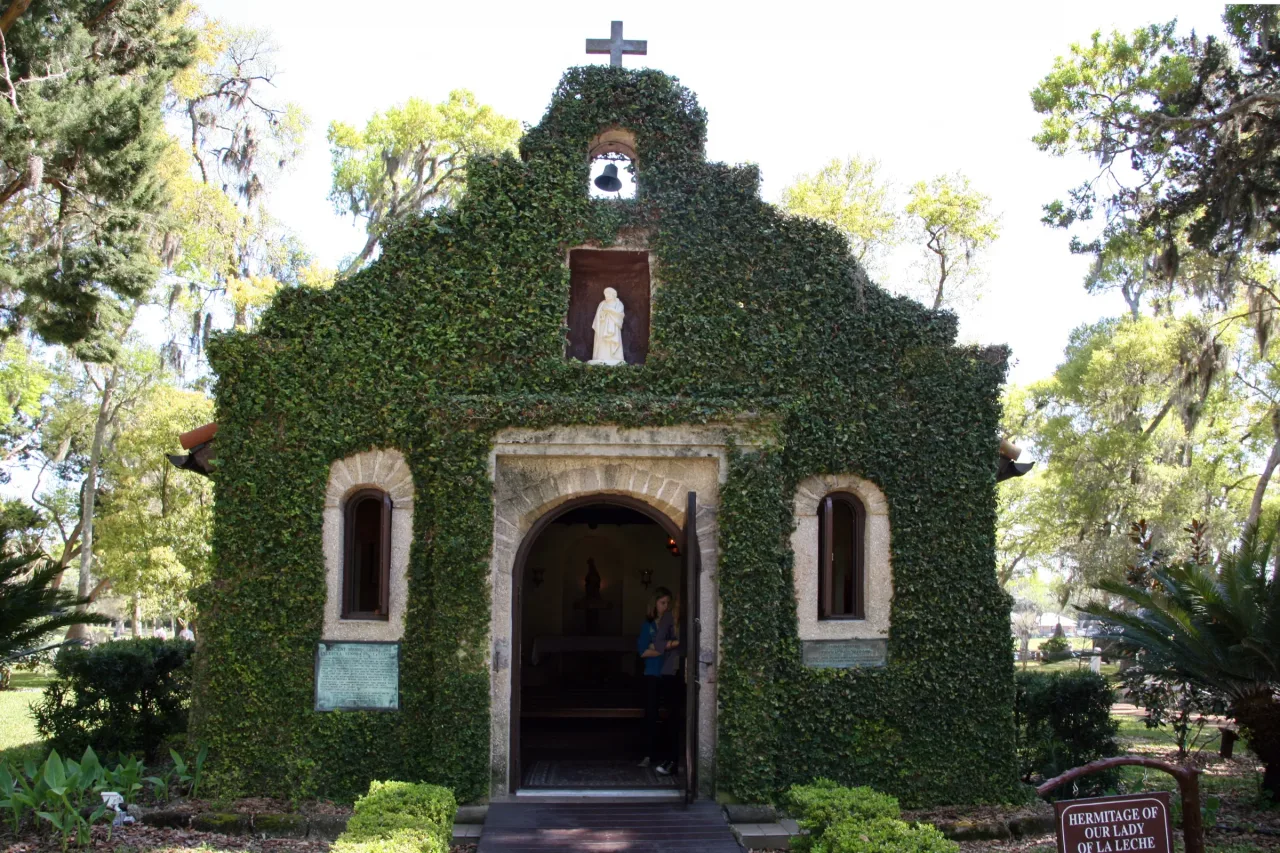
The ground where this parish began on September 8, 1565, kept as the national shrine of Our Lady of La Leche. About a mile north.
This parish's Black Catholic mission church in Lincolnville, with relics of Saint Benedict the Moor and Saint Carlo Acutis.
Official church sources.
August 26, 2026
Use this for corrections, broken links, missing places, and planning ideas.