Tomb of Saint Carlo Acutis
Saint's tomb
Diocese of Assisi and the official sanctuary
Assisi's first cathedral, beside the bishop's palace where Francis renounced his father's wealth, and the tomb of Saint Carlo Acutis.
Two saints bring pilgrims to this small church in the upper town.
In 1206 or 1207, before the bishop of Assisi, whose palace stands next door, the young Francis stripped off his clothes, handed them back to his father, Pietro di Bernardone, and said: "Until now I have called you my father on earth. From now on I can say with complete confidence: Our Father, who art in heaven." Bishop Guido covered him with his own mantle.
Eight centuries later Carlo Acutis, a Milanese teenager who spent long holidays in Assisi and went to Mass every day, sometimes in this church, was laid to rest here in 2019. Since his canonization in 2025 the sanctuary has drawn pilgrims from all over the world, above all the young.
Santa Maria Maggiore was the first cathedral of Assisi. A local legend says Saint Savinus, the city's second bishop, built it in the fourth century over a Roman house, the domus of Propertius, whose remains lie beneath the church. In 1035 the cathedral moved to San Rufino. The church was rebuilt in the twelfth century, and its rose window is inscribed with the year 1163. In 1216 the apse was rebuilt again, and a stone records the names of Bishop Guido and of Francis.
The bishop's palace stands beside it. The early lives of Francis place his renunciation before Bishop Guido, in the quarrel with his father that marked his conversion. Assisi remembers it in a room of the palace now called the Sala della Spogliazione, with a painting of the scene attributed to Cesare Sermei. The bishop of Assisi later made the church the Sanctuary of the Renunciation, and Pope Francis stopped in the Sala on October 4, 2013.
Carlo Acutis was born in London on May 3, 1991, and grew up in Milan. He died of leukemia on October 12, 2006, at fifteen, offering his illness for the Pope and the Church. His body was brought here on April 6, 2019. He was beatified in the Basilica of Saint Francis on October 10, 2020, and canonized in Rome on September 7, 2025.
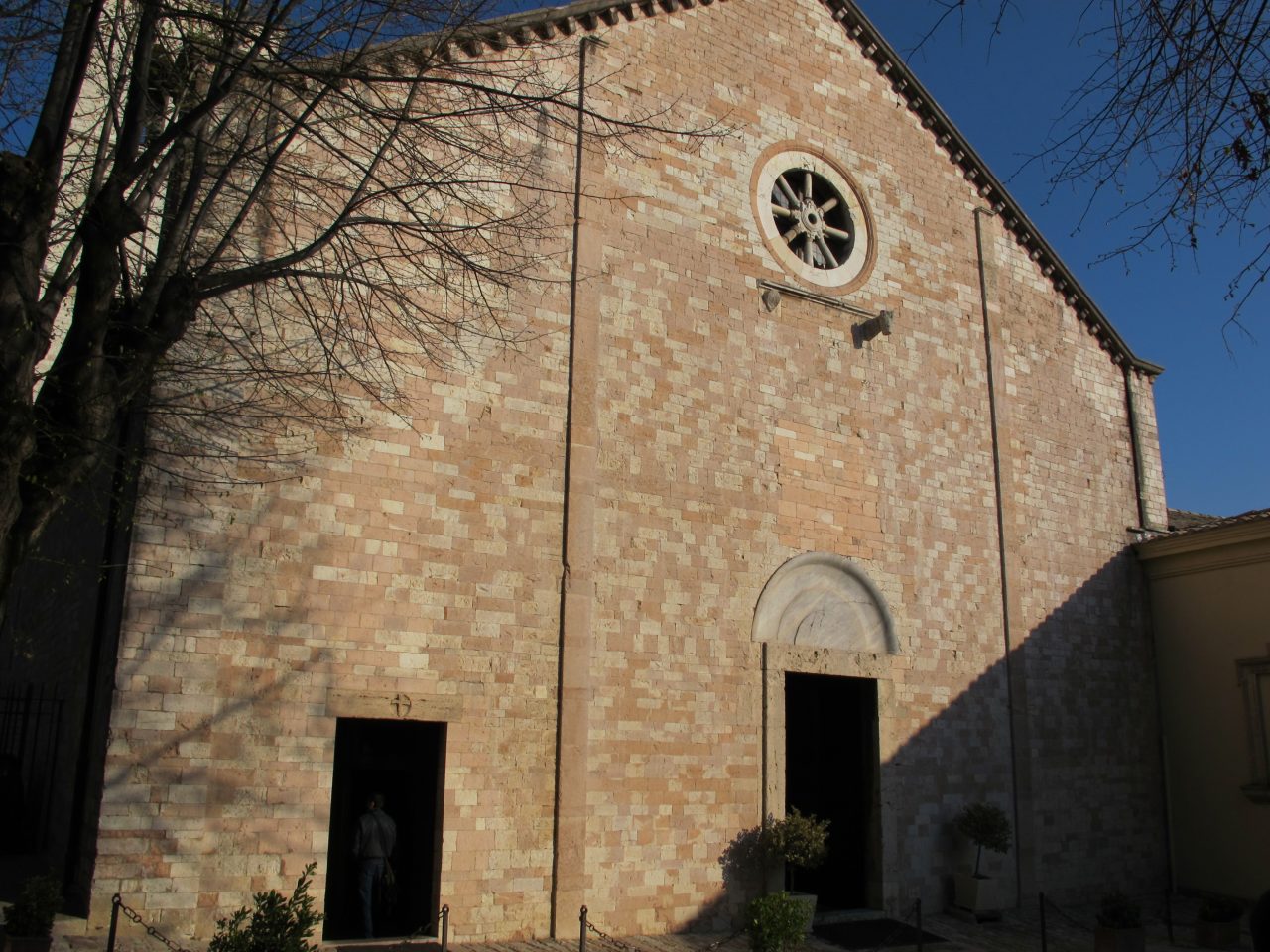
The church is plain and small, in pale Assisi stone, with the rose window of 1163 in a facade that took its present form in 1938; the earthquake of 1832 had brought down the roof and the right aisle. Carlo's body lies in a glass tomb in the church, on view to pilgrims. In the sacristy, fourteenth-century frescoes show the Nativity, Christ blessing, and Saints Mary Magdalene, Peter, Rufinus and Catherine of Alexandria. Below, guided visits at midday go down to the Roman house.
The church is small. Pray at Carlo's tomb, then see the room of Francis's renunciation in the bishop's palace next door.
The room in the bishop's palace where Assisi remembers the renunciation, with a painting of the scene attributed to Cesare Sermei.
Guided visits at midday go down to the domus of Propertius, beneath the church.
Francis's renunciation made his conversion public. He gave up his inheritance to depend on God alone, and the bishop took him into the Church's care. Carlo, who knew this church, called the Eucharist his "highway to heaven." Pilgrims pray at his tomb for their own faith, for young people, and for the sick.
His body lies in a glass tomb in the church, on view to pilgrims.
In the bishop's palace next door, where Assisi remembers Francis giving back his clothes.
On the facade, inscribed DOMINI 1163 IHOANNES FECIT.
The domus of Propertius beneath the church, on guided visits at midday.
The church and Carlo's tomb, then the Sala della Spogliazione in the bishop's palace next door.
San Rufino for the font of Francis's baptism, the Spogliazione for his renunciation and Carlo's tomb, and Chiesa Nuova for the family home that local tradition gives him.
It pairs naturally with San Rufino, a few minutes uphill, and Chiesa Nuova, across the center.
On Sundays and feast days, visits to the church and the tomb pause from 10:30 AM to 12:30 PM for the 11:00 AM Mass, and anyone attending must be inside by 10:30. Guided visits to the Roman house beneath the church run at midday, and the crypt is closed during celebrations. The Sala della Spogliazione is in the bishop's palace next door.
San Rufino, where tradition says Francis and Clare were baptized, is a few minutes uphill; Chiesa Nuova, built where local tradition places the house of Francis's family, is across the center.
The sanctuary marks Francis’s renunciation before Bishop Guido and holds the body of Saint Carlo Acutis. Its current timetable lists continuous daytime opening, with a separate Sunday and feast-day pause for visits to the sanctuary and tomb during Mass.
Access and hours
Two things are kept here
Source note Traditional attributions are presented as tradition, with documentation named where it exists.
Where this church sits within the wider Catholic geography of Assisi.
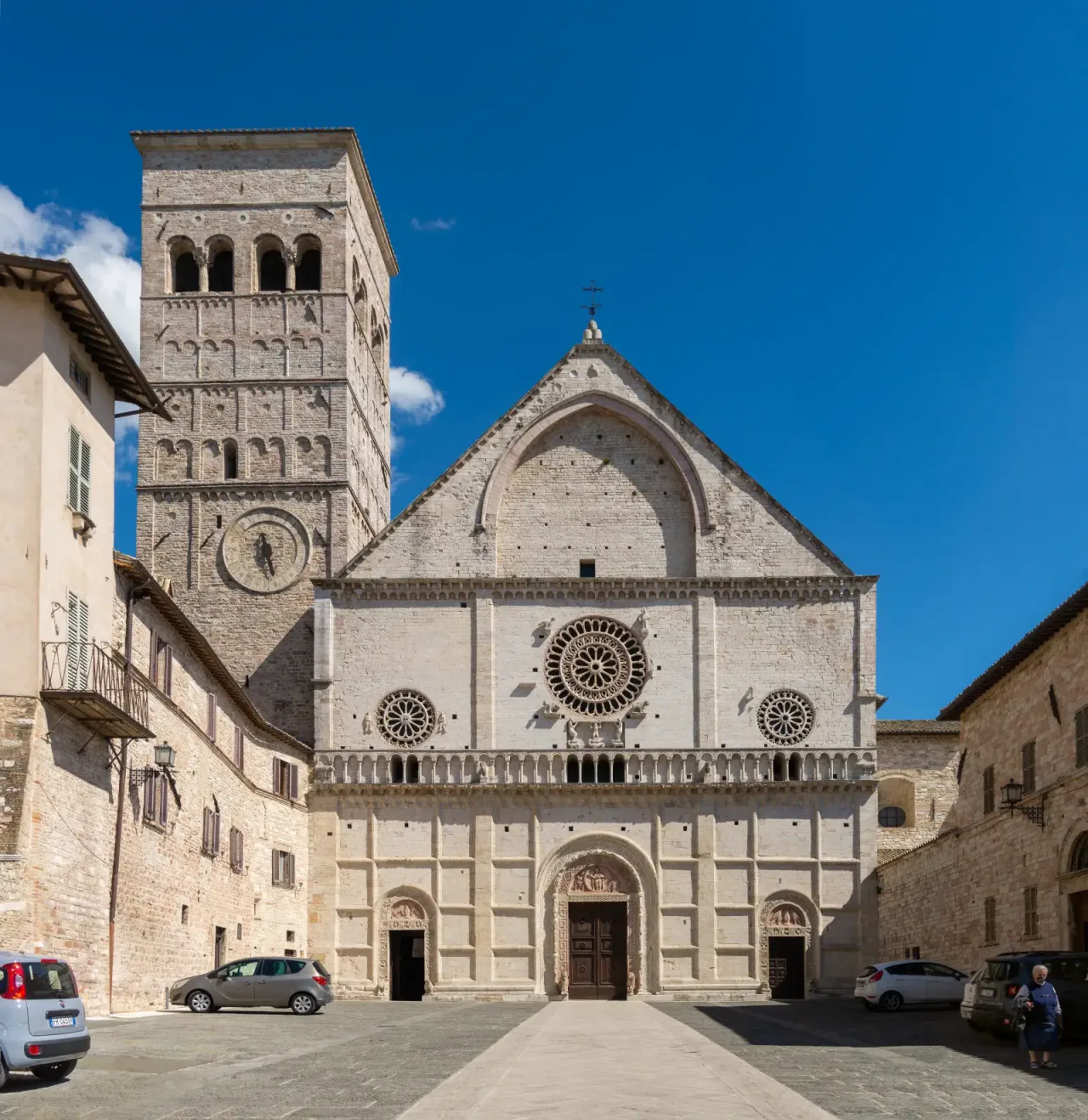
The cathedral of Assisi and the church of the baptismal tradition of Francis and Clare.
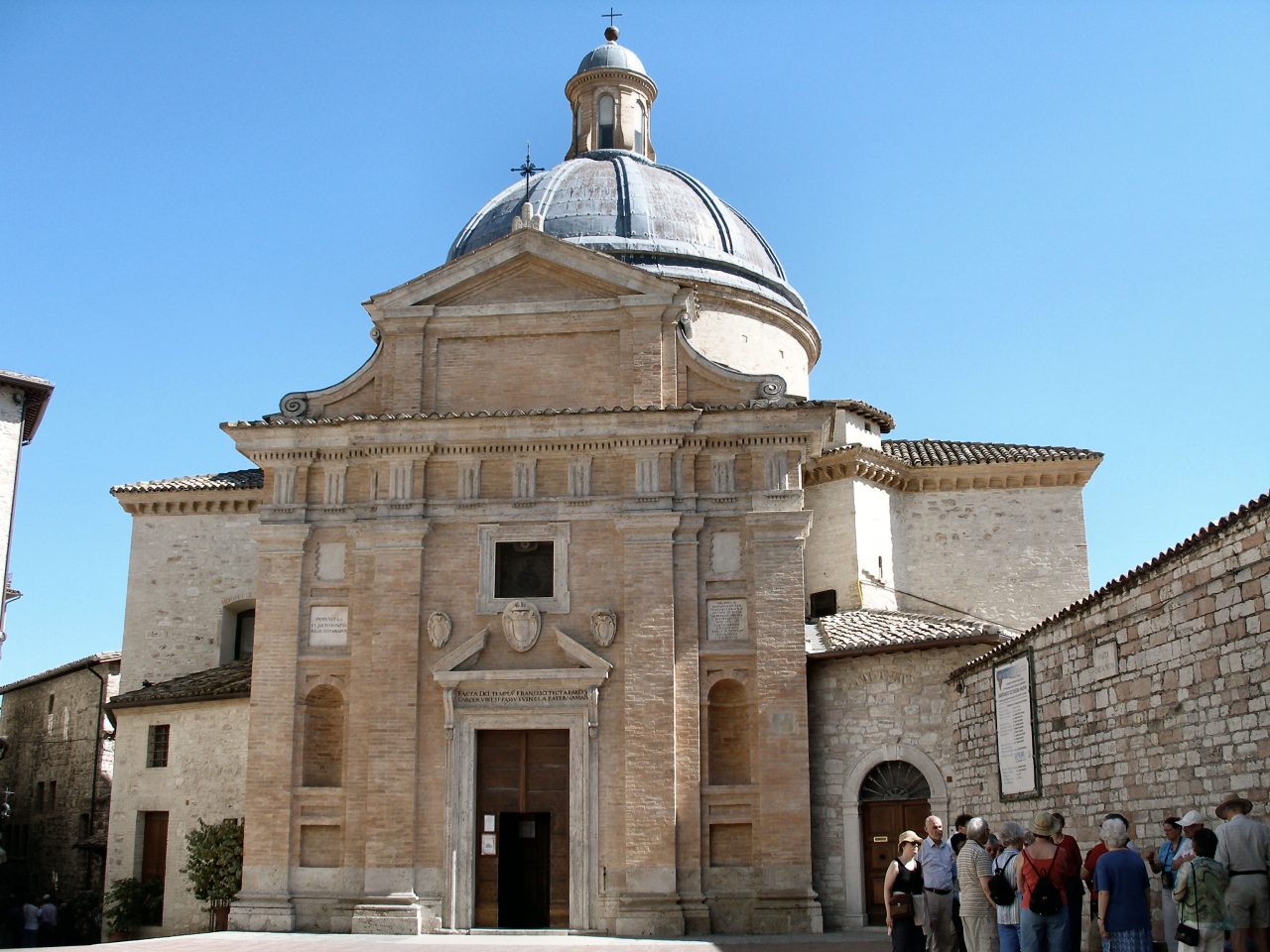
The church built over the place long held by local tradition to be Francis's family house.
The basilica of Clare's tomb and the original San Damiano Crucifix on the southern side of the old town.
Santa Maria Maggiore is held by its episcopal setting, the renunciation tradition of Francis, and the tomb of Saint Carlo Acutis. These are related, but they are not interchangeable memories.
The sanctuary stands in Santa Maria Maggiore beside the former episcopal complex in the historic center of Assisi.
Assisi receives this episcopal setting as the place of Francis's renunciation before his father; the tradition should not be turned into a claim of a preserved courtroom scene.
Saint Carlo Acutis is venerated in the sanctuary church, where his body was brought to Assisi in 2019.
The Diocese of Assisi and the official sanctuary identify this church as the place of Carlo Acutis's tomb and present it for public veneration.
A short old-town continuation to the church built over the site long held in Assisi's tradition to be Francis's family home.
Official sanctuary guidance for current prayer, liturgy, and tomb-access arrangements.
The sanctuary and the Diocese of Assisi distinguish the long-held Franciscan renunciation tradition from archaeological certainty. Carlo Acutis's tomb is a documented, living place of veneration in the church.
History follows the sanctuary's own historical notes and the Diocese of Assisi.
October 26, 2026
Use this for corrections, broken links, missing places, and planning ideas.