
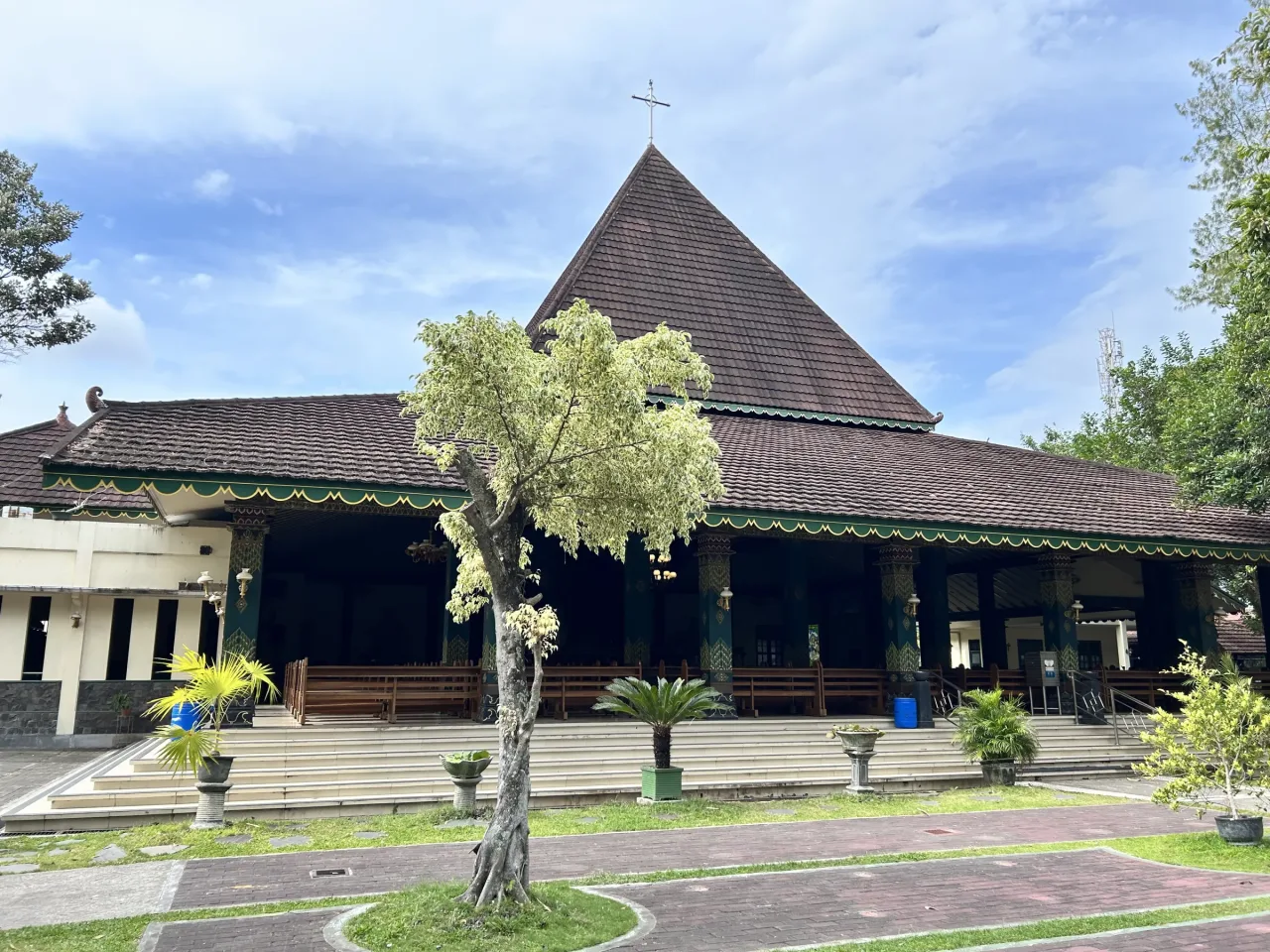
Sacred Heart Church and Candi Ganjuran
The Sacred Heart parish at Ganjuran, south of Yogyakarta, with the candi in which Christ is venerated as a Javanese king.
- Location
- Bambanglipuro, Indonesia 7.9264° S · 110.3196° E
- Type
- Parish church of the Sacred Heart, with the Candi Hati Kudus Tuhan Yesus
- Dedication
- The Sacred Heart of Jesus (Hati Kudus Tuhan Yesus)
Christ the King, in the language of Java
Come here to pray before the Sacred Heart in a form the Church in Java made its own.
The parish church is a working church. The candi beside it is not a decorative extra. Inside it, Catholics kneel before Christ shown as a Javanese ruler, with the Javanese inscription naming him Sampeyan Dalem Maha Prabu Yesus Kristus, Pangeraning para bangsa: the great king, lord of the nations. This is inculturation, not novelty. The faith is the Sacred Heart. The visual language is Java's.
A Catholic family, a parish, a candi
The Schmutzer family, Catholic managers of the Gondanglipuro sugar mill, built a church here in the 1920s. The altar was blessed on August 20, 1924 by Mgr van Velsen, Vicar Apostolic of Batavia. The Archdiocese of Semarang records that the Holy See permitted the Javanese altar image and the Sacred Heart statue; the church building itself remained in a Dutch register. That distinction matters. Inculturation here was not a costume put on an ordinary European church. It was a request to say who Christ is in Java.
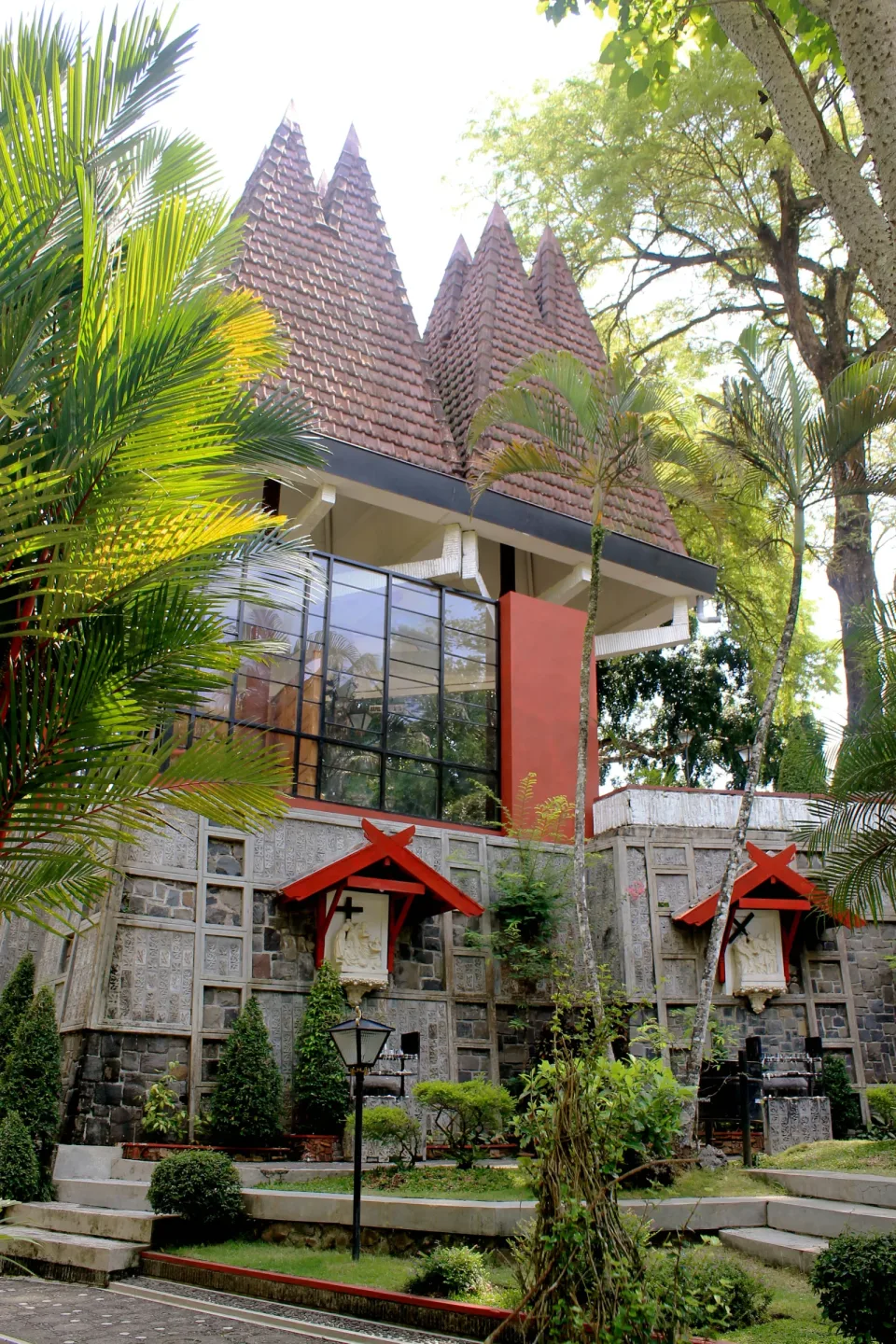
The candi followed. The first stone was laid on December 26, 1927. A smaller Sacred Heart image was placed in the foundation, so that if the building fell, Christ would still be there. Mgr van Velsen blessed the candi on February 11, 1930, the feast of Our Lady of Lourdes. The Yogyakarta heritage record says the day was also kept as a thanksgiving after the world monetary crisis, and as a dedication of the land to the Sacred Heart.
In 1940 the place became a parish. Fr Albertus Soegijapranata SJ, later the first native Indonesian bishop, was its first parish priest. The 2006 earthquake damaged the church badly and left the candi standing. The present church was blessed in 2009 by Mgr Ignatius Suharyo. The parish still sings with gamelan. Mass is still offered in Javanese.
Walk the compound before choosing a door. The church is the parish's ordinary house: nave, towers, a roof that reads as a church. The candi is a Javanese temple form, facing south, with stairs east and west, a small inner chamber, and carved wooden doors. Inside, the Sacred Heart image stands as Kristus Raja in Javanese royal dress, the right hand indicating the opened Heart. Behind him the Javanese inscription names him king and lord of the nations. The two buildings are one Catholic complex. The candi is not a Hindu remainder. It is a Christian prayer in a Javanese architectural sentence.
How to read Ganjuran.
The candi is the theological argument. The church is the parish.
The inscription
Sampeyan Dalem Maha Prabu Yesus Kristus, Pangeraning para bangsa. Stay with those words. They are the reason the image is dressed as a Javanese king.
Inculturation, not costume
The Javanese form is how this Church says who Christ is. It is not a theme applied to an ordinary European church.
A working parish
Mass in Javanese, gamelan, a living congregation. Do not visit only the candi and miss the church.
Spiritual Significance
This is a parish. People come to Mass at dawn and on Sunday. Pilgrims come to the candi, sit before Christ, and take water from the spring called Tirta Perwitasari. Receive that water as pilgrims receive holy water elsewhere: as a sacramental of prayer, not as a medical claim. The Javanese Christ is not a curiosity for visitors. He is the Lord this parish adores.
Do Not Miss
-
Prayer inside the candi
Kneel before Christ the King. Read the Javanese inscription if you can, or let someone read it to you.
-
The opened Heart
The right hand indicates the Sacred Heart. The royal dress is in service of that offering, not instead of it.
-
Mass in the parish church
The candi is not the whole of Ganjuran. The parish still gathers for the Eucharist, including in Javanese.
- That the candi is small. It is a chamber for prayer, not a monument for crowds.
- That gamelan in the liturgy is not performance. It is how this parish sings.
- That pilgrims take water here as a devotion. Do not turn that into a medical story.
Visit Plans
An hour covers the candi, the church, and a quiet prayer. Morning Mass makes the place itself.
How to Visit
Begin with the candi if you came as a pilgrim, then enter the church as a parish church. If you can, stay for Mass. The Archdiocese of Semarang lists daily Mass at 05:30, Saturday Mass in Javanese at 16:00 and in Indonesian at 18:00, Sunday Mass in Javanese at 07:30 and in Indonesian at 17:00. Confirm with the parish. Ganjuran is about twenty kilometers south of Yogyakarta, in Sumbermulyo, Bambanglipuro, Bantul.
Mass in the parish church. Confirm current times with the parish.
The Archdiocese of Semarang publishes a parish schedule. The parish itself remains the schedule of record.
- Daily Mass
- 05:30, as listed by the Archdiocese
- Sunday
- 07:30 Javanese; 17:00 Indonesian
- Entry
- Parish compound; no ticketed shrine gate
- Candi
- Open for prayer in the compound
Prayer and liturgy
- Confirm times with the parish before traveling. First Friday and feast arrangements change.
- Mass in Javanese is part of the parish's ordinary life, not a demonstration for visitors.
Visiting and access
- Pilgrims pray at the candi and may take water from the spring as a devotion. Healing claims are not declared as fact.
- Secretariat hours are listed by the Archdiocese as Monday to Friday 07:30–18:00, Saturday and Sunday 07:30–20:00.
Continue Your Pilgrimage
Map
Architectural specifics and inscription from Yogyakarta cultural-heritage record. Parish identity and Mass list from Archdiocese of Semarang parish page, reviewed 2026-09-17. Water described devotionally only. Inculturation, not syncretism.
September 17, 2026
Photo credits
- Hero. Inkravtania / Wikimedia Commons (CC BY-SA 4.0). Source. CC BY-SA 4.0.
- Candi Hati Kudus Tuhan Yesus. Inkravtania / Wikimedia Commons (CC BY-SA 4.0). Source. CC BY-SA 4.0.
- Kristus Raja. 2DSC06389A Christ as a Javanese Prince, Ganjuran, Bantul, Java, Indonesia. Arjovanderjagt / Wikimedia Commons (CC BY 3.0). Source. CC BY 3.0.