
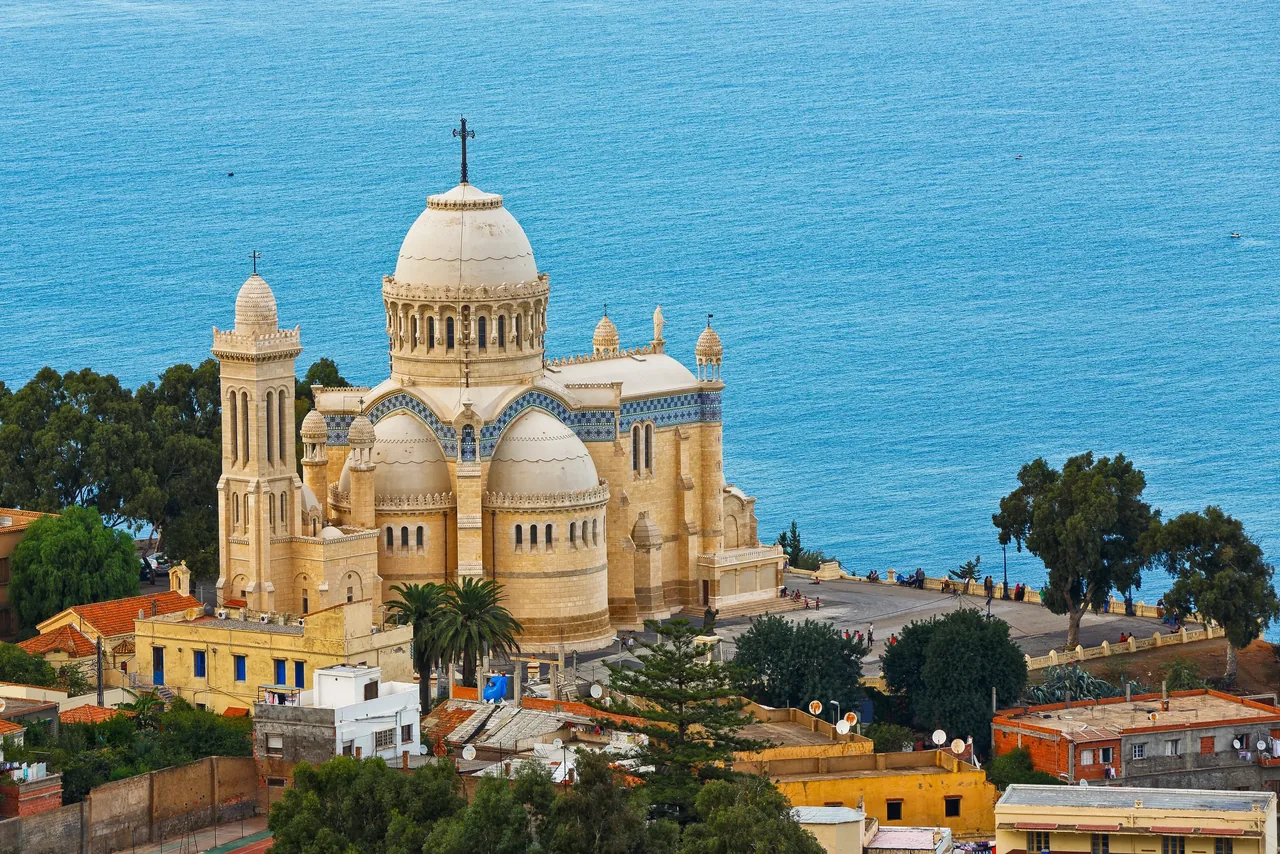
Basilica of Notre-Dame d'Afrique, Algiers
A living Marian basilica above Algiers where Mass is said daily and the whole country, Christian and Muslim, comes to visit.
- Location
- Algiers, Algeria 36.8022° N · 3.0428° E
- Type
- Catholic basilica and Marian sanctuary Roman-Byzantine basilica of 1872 by the architect Jean-Eugene Fromageau, above the bay of Algiers
Where Algiers comes to Our Lady
The Catholic community in Algeria is very small. This basilica is not. Every day people arrive from all over the country and from abroad, most of them not Catholic, to look out over the bay and to light a candle. Catholics come to pray the Rosary and go to Mass. The inscription in the apse asks Our Lady to pray for us and for the Muslims, and that petition is the character of the place: not a slogan about coexistence, but a Marian prayer said by a minority Church for the people it lives among.
Two women from Lyon, a ravine, and a basilica
The devotion did not begin with a bishop. The diocese credits it to two very modest women from Lyon, Marguerite Berger and Anna Cinquin, who worked cleaning at the seminary in Algiers and began coming to a ravine on the hillside to pray. From 1846 to 1857 the pilgrimage was there. Then it moved to a chapel of Saint Joseph, still visible from the street, and in 1872 to the basilica that stands now, built under Bishop Pavy to the design of Jean-Eugene Fromageau. Cardinal Lavigerie came to Algiers in 1866 and founded the Missionaries of Africa, the White Fathers, in 1868, and the White Sisters the year after. The basilica belongs to the colonial period of the Church in Algeria, and the Church there says so plainly. What it has become since independence is something the colonial period did not plan: a shrine that the whole country treats as its own.
A Roman-Byzantine basilica set high above the bay, visible from the sea. The devotional centre is the statue of Our Lady of Africa and the apse inscription asking her prayer for Christians and Muslims.
The pilgrimage began with two women from Lyon, Marguerite Berger, known as Mademoiselle Agarithe, who died in 1875, and Anna Cinquin, who died in 1884. Both worked in maintenance at the seminary in Algiers.
It moved through three places: the Ravine from 1846 to 1857, about 500 metres west of the present basilica; the chapel of Saint Joseph from 1857 to 1872; and the present basilica from 1872.
Algerians call her Lalla Meriem, or Madame l'Afrique.
The diocese describes the basilica as a place of prayer for Christians and for Muslims, of peace, of listening and of dialogue.
Pope Leo XIV came to Notre-Dame d'Afrique during his April 2026 visit to Algeria.
Our Lady of Africa, pray for us and for the Muslims. The basilica has prayed that sentence for over a century, and means it.
This is a working sanctuary. Mass is celebrated every day, the Rosary is prayed every afternoon except Friday, and the rector's office takes bookings for groups and pilgrimages. The sanctuary publishes a prayer for those who light a candle: Mary, I do not know how to pray very well and I cannot stay here all day, so I light a candle which is a part of what I have and what I am.
Do Not Miss
-
Mass
Daily at 18.00. The basilica is a parish before it is a viewpoint.
-
The apse inscription
Our Lady of Africa, pray for us and for the Muslims.
-
The candles
Read the prayer the sanctuary publishes for those who light one.
-
The chapel of Saint Joseph
Visible from the street; the second stage of the pilgrimage, from 1857 to 1872.
- That most people here are not Catholic, and that this is normal
- That the devotion began with two women who cleaned a seminary
- That the basilica is a colonial-era building serving a post-colonial Church, and neither fact is hidden
- The local name Lalla Meriem
How to Visit
The basilica is above the Bologhine district, north-west of central Algiers. It opens in the morning from 11.00 to 12.30 and in the afternoon from 15.00 to 17.30, and is closed on Fridays. Mass is at 18.00 daily and at 10.30 on Fridays, with the Rosary at 17.40 except Fridays. Groups, delegations and pilgrimages must contact the rector in advance.
- Mass every day
- The Rosary each afternoon except Friday
- The prayer of the basilica for Christians and for Muslims
- Lighting a candle, which the sanctuary itself describes as what most visits come down to
Closed Fridays; groups must book ahead.
The basilica publishes its hours and Mass times directly. Friday is Algeria's day of rest, so the Friday Mass is in the morning and the building is closed to visitors that day. The rector asks that groups, delegations and pilgrimages make contact in advance. Algeria requires a visa for most travellers.
- Mass
- Every day at 18.00; Friday at 10.30; feast days at 10.00
- Rosary
- Every day except Friday at 17.40
- Open
- Mornings 11.00-12.30, afternoons 15.00-17.30; closed Friday
- Groups
- Book in advance with the rector: recteur@notre-dame-afrique.org
Current access
Prayer and custody
Relics, Tombs, Sacred Objects
Tomb and Burial
- No saint is buried here.
Relics and Sacred Tradition
- No relic claim is published for the basilica. Its devotion is Marian.
Sacred Objects
- The statue of Our Lady of Africa
- The inscription asking Our Lady's prayer for Christians and for Muslims
- The candle stands, and the prayer the sanctuary publishes for those who light them
Continue Your Pilgrimage

Map
Hero image sourced from Wikimedia Commons (Chettouh Nabil, CC BY-SA 4.0). This is a Marian basilica and place of pilgrimage, not an apparition shrine: no apparition is claimed here, as at Częstochowa and Aparecida. The devotion here is to Our Lady herself, under the title of Our Lady of Africa. All hours, Mass times, pilgrimage origins and the candle prayer are from the diocesan page.
September 17, 2026
Photo credits
- Hero. Chettouh Nabil, CC BY-SA 4.0, via Wikimedia Commons. Source. CC BY-SA 4.0.