
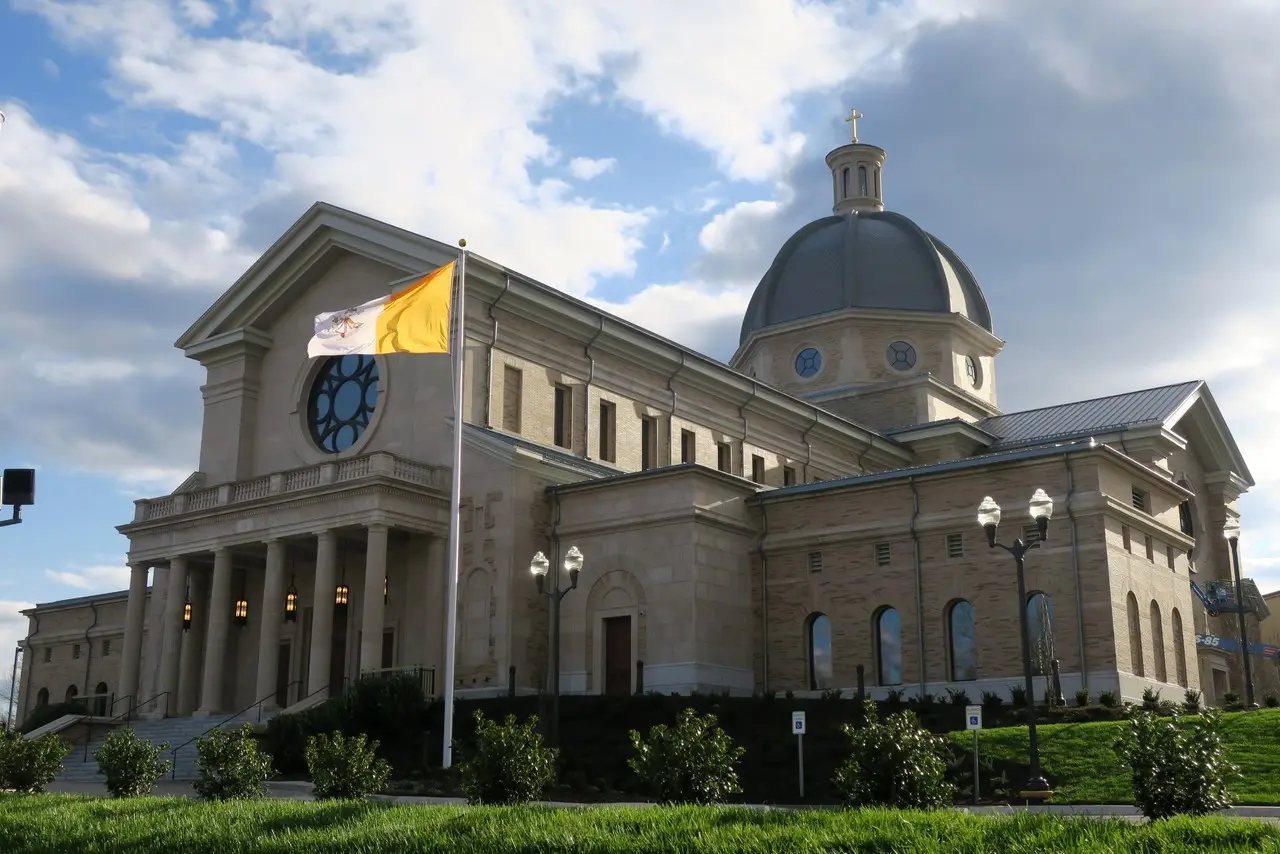
Cathedral of the Most Sacred Heart of Jesus

Dedicated in 2018, Knoxville's cathedral brings the relics, sacred objects, prayer, and memory of the earlier church into the bishop's church for East Tennessee.

UNITED STATES · KNOXVILLE 35.9247° N · 83.9991° W
Location
Knoxville, Tennessee, United States 35.9247° N · 83.9991° W
Type
Cathedral Renaissance Revival with classical and liturgical design language
Dedication
The Most Sacred Heart of Jesus
Why Go

A Cathedral for East Tennessee

Sacred Heart began in 1956 as a parish of 199 families. When Pope Saint John Paul II established the Diocese of Knoxville in 1988, the parish church became its cathedral. The present building, the first cathedral constructed specifically for the diocese, was dedicated on March 3, 2018.

Bishop Richard Stika entrusted the project to Father David Boettner, then rector of the cathedral and a vicar general of the diocese. Father David oversaw the work for the diocese through three years of construction and the dedication. In a July 2026 conversation with Eternal Roam, he recalled that parts of the design drew inspiration from the Basilica of San Clemente in Rome. The cathedral's official tour booklet also identifies the influence of Brunelleschi's dome in Florence and records the older sacred objects incorporated into the new church.

Read the Place

Stand at the crossing before moving closer.

Stand near the crossing before moving closer. From there, the cathedral's principal elements can be seen together, while their individual details remain within reach.

The altar

The ten-foot Michelangelo Statuario marble altar carries mosaics of Alpha and Omega, the victorious Lamb upon the seven-sealed scroll, and the Chi-Rho.

The baldacchino and tabernacle

The 45-foot wooden baldacchino is painted to resemble marble. Behind the altar stands a bronze-and-marble tabernacle more than a century old, brought from a closed church in the Netherlands.

The dome and pendentives

The Florence-inspired dome rises 107 feet to the oculus. The Sacred Heart, Holy Family, apostles, saints, and four Evangelists make its whole program legible from beneath the crossing.

The cathedra and side altars

The white-oak cathedra stands beneath the bishop's coat of arms. Across the transepts, the Marian and Saint Joseph altars retain statues transferred from the former cathedral.

Inside Nave, Crossing, Sanctuary From the loft, the nave leads through the crossing toward the altar and baldacchino, with the dome rising above the meeting of the church's axes.
Spiritual Significance

A cathedral is not defined by its scale. It is the church that contains the bishop's chair and serves as the principal church of the diocese.

Ordinations, the Chrism Mass, and other major diocesan liturgies bring Catholics here from across East Tennessee. At the same time, Sacred Heart remains an active parish church, with daily Mass, confession, Eucharistic adoration, and the ordinary prayer of its own community.

Sanctuary Altar and Baldacchino The marble altar stands beneath the 45-foot baldacchino, with the historic tabernacle behind it.
Dome and Pendentives The Saints Above the Crossing The Sacred Heart, Mary, Joseph, apostles, saints, and the Evangelists gather the cathedral's iconographic program above the crossing.
Do Not Miss · 5 stops

Five details that make the whole building clearer.

  1. The Lamb on the altar

    The central mosaic shows the victorious Lamb resting upon the scroll with seven seals. It is one of the clearest references to the Book of Revelation in the cathedral.

  2. The baldacchino inscriptions

    Walk around the sanctuary far enough to read more than one side. The inscriptions move from the Incarnation to the Eucharist and from Christ's identity to his care for the Church.

  3. The saints around the dome

    Do not look only at the large Sacred Heart image. The saints below include martyrs, missionaries, religious founders, and witnesses drawn from several nations represented within the diocese.

  4. Mark and Luke in the pendentives

    Mark's Gospel book is partly hidden beneath his cloak, a reference to the gradual disclosure of Christ's identity in his Gospel. Luke appears with painter's tools and an icon of Mary and the Christ Child, recalling the tradition that regarded him as the first Christian iconographer.

  5. The relic of Blessed Stanley Rother

    A first-class relic of Blessed Stanley Rother has been displayed inside the cathedral since 2025. Rother, a priest of Oklahoma murdered while serving in Guatemala, was recognized by Pope Francis as a martyr.

What to notice
  • The five consecration crosses cut into the altar mensa.
  • The Alpha and Omega and Chi-Rho mosaics flanking the Lamb.
  • The wood of the baldacchino painted to resemble marble.
  • Credo in Unum Deum inside the cupola, the opening words of the Nicene Creed.
  • The wheat and grapes worked into the doors of the tabernacle.
  • The statues of Mary and Joseph carried from the former cathedral.
  • The bishop's coat of arms above the cathedra.
Visit Plans · 3 plans · add to a journey

How much time, and what to do with it.

  • Duration Allow 30 min Best for A first encounter

    A Short Visit

    4 ordered stops

    Begin in the nave, pause beneath the dome, and spend most of the visit near the sanctuary. This route gives a clear reading of the cathedral without trying to account for every image.

    1. Nave and crossing
    2. Altar and baldacchino
    3. Dome and Evangelist pendentives
    4. Tabernacle and cathedra
  • Duration Allow 1 hr Best for A close reading of the art

    Read the Art and Architecture

    6 ordered stops

    Allow time to move around the transepts and look closely at the inscriptions, mosaics, and saints. The smaller details explain the building better than a single wide view.

    1. Exterior, narthex, and baptismal font
    2. Marian and Saint Joseph side altars
    3. Altar mosaics and baldacchino inscriptions
    4. Tabernacle and cathedra
    5. Dome saints and Evangelist pendentives
    6. Relics and sacred objects
  • Duration Plan around Mass or adoration Best for Visitors who can stay to pray

    Come for the Liturgy

    5 ordered stops

    Arrive early enough to see the interior before the liturgy begins. After Mass, remain for a few minutes at the tabernacle or continue to the Divine Mercy Adoration Chapel.

    1. Arrive 15 to 20 minutes before Mass
    2. Pause beneath the crossing
    3. Participate in the liturgy
    4. Visit the Blessed Stanley Rother relic
    5. End in the adoration chapel
How to Visit

A Clear Route Through the Cathedral

Enter through the narthex and follow the central axis toward the crossing. From there, move around the sanctuary rather than trying to read everything from the nave.

During Mass, confession, or private prayer, give the sanctuary and occupied pews appropriate space.

  • Narthex and baptismal font Begin at the entrance and locate the font in the south transept.
  • Nave and crossing Walk the central aisle, then stop beneath the dome where the nave and transepts meet.
  • Altar Look closely at the three mosaic medallions and the five crosses cut into the mensa.
  • Baldacchino and tabernacle Read the inscriptions around the canopy, then look behind the altar for the historic tabernacle and Ecce Agnus Dei.
  • Dome and pendentives Identify several saints around the drum before turning to the Evangelists at the dome's base.
  • Side altars and cathedra Visit the Marian and Saint Joseph altars, then locate the bishop's chair and coat of arms.
  • Relics and adoration Find the relic of Blessed Stanley Rother. The Divine Mercy Adoration Chapel on the cathedral campus offers a quieter place for prayer and is open around the clock.
Current Practical Information · reviewed July 14, 2026

Plan Around the Liturgy

The cathedral is a living parish and the bishop's church. Confirm times and access on the official cathedral site before traveling.

Role
Mother church of the Diocese of Knoxville
Entry
Free
Address
711 S. Northshore Drive, Knoxville
Cathedral hours
Generally 6:00 a.m. to 6:00 p.m.
Parking
Available on the cathedral campus
Adoration chapel
Open 24 hours a day
Regular Masses
Monday through Friday at 8:05 a.m. and noon; Saturday at 8:05 a.m. and 5:00 p.m.; Sunday at 7:30 a.m., 9:00 a.m., 11:00 a.m., and 1:00 p.m. in Spanish.
Confession and Eucharistic adoration
Confession is offered Wednesday evening and after the Saturday morning Mass. Eucharistic adoration is held in the cathedral on Wednesday evening.
Additional schedule notes

Schedules and access

  • Confirm times and access on the official cathedral site before traveling.

Address and parking

  • Major liturgies and events may affect access.
Relics, Tombs, Sacred Objects

Relics and Sacred Objects

Blessed Stanley Rother

First-class relic

Displayed inside the cathedral for prayer and veneration.

Cathedral Tour Booklet · official cathedral site
Documented

The cathedral received a first-class relic of Blessed Stanley Rother from the Archdiocese of Oklahoma City. It was placed on public display in 2025 for prayer and veneration.

Relics in the altar

Relics of Pope Saint Clement of Rome and Saint Laetus

Enclosed within the altar of the present cathedral.

Cathedral Tour Booklet
Documented

Relics of Pope Saint Clement of Rome and Saint Laetus were placed in the former cathedral altar when it was consecrated in 1957. They were transferred to the altar of the present cathedral during its dedication.

The wider relic collection

Relics of saints across the Church

The collection is held within the cathedral's wider life of prayer and veneration.

Cathedral Tour Booklet
Documented

The cathedral's tour booklet lists relics associated with the Holy Cross, Saint Andrew the Apostle, several popes, missionaries, religious founders, and modern saints, including Saint Frances Xavier Cabrini, Saint John Neumann, Saint Elizabeth Ann Seton, Saint Margaret Mary Alacoque, Saint Maria Goretti, Saint Charbel Makhlouf, Saint Teresa of Kolkata, and Saint Faustina Kowalska.

The principal sacred objects

Altar, tabernacle, baldacchino, cathedra, and transferred statues

Visible in the sanctuary and transepts.

Cathedral Tour Booklet
Documented

The principal sacred objects include the Michelangelo Statuario altar, the century-old tabernacle, the 45-foot baldacchino, the cathedra, and the statues transferred from the former cathedral.

Source note Traditional attributions are presented as tradition, with documentation named where it exists.

Map · Knoxville, Tennessee, United States

Plan around this place.

Editorial sources

Edited from official church sources, local image provenance, and Eternal Roam destination records.

Official

shcathedral.org

Image credits
All photography credits
Last reviewed

July 14, 2026