
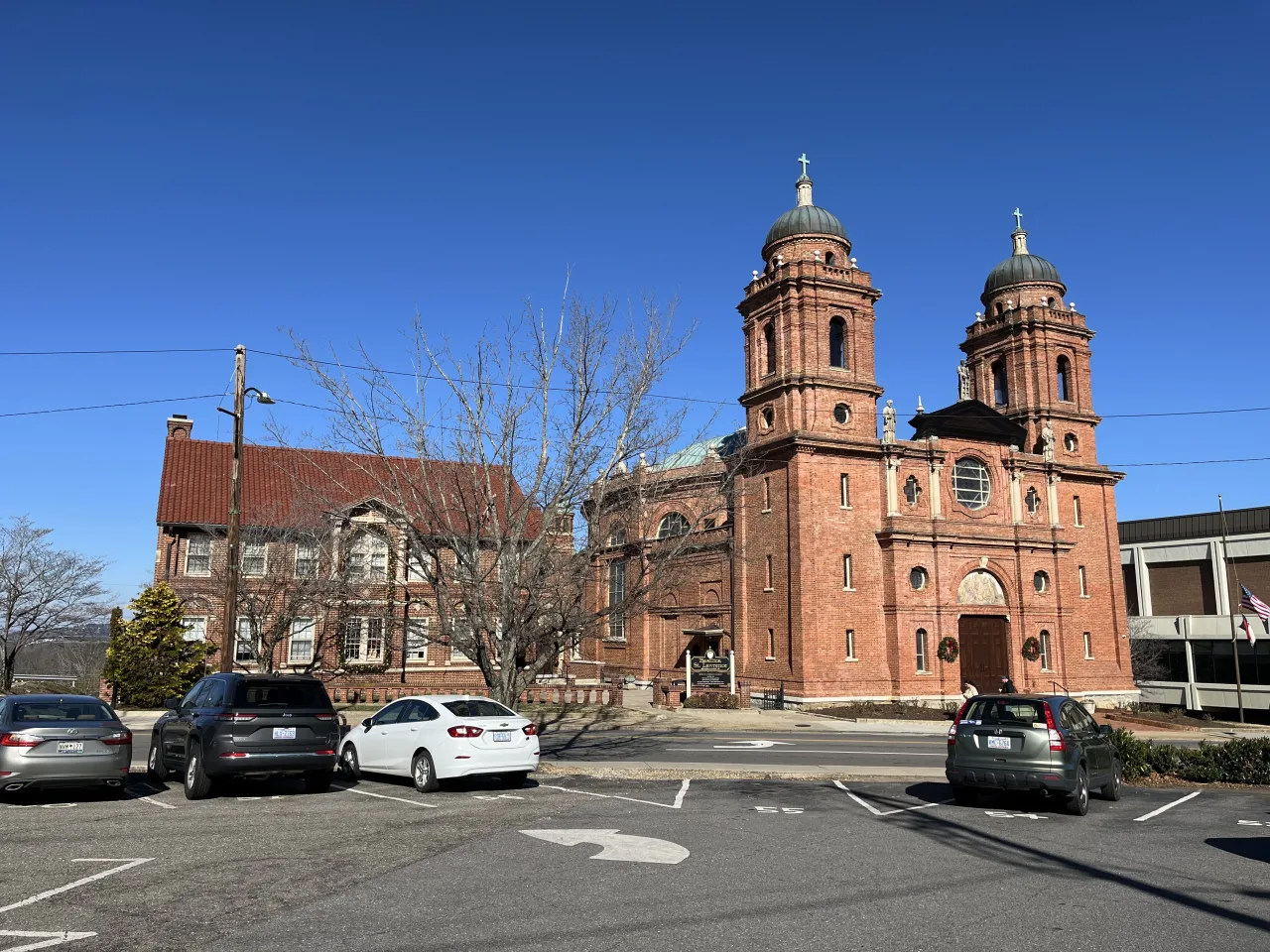
Basilica of Saint Lawrence
Saint Lawrence joins a living downtown parish to one of America's most distinctive sacred interiors, while a necessary restoration asks pilgrims to plan with humility.
- Location
- Asheville, North Carolina, United States 35.5973° N · 82.5563° W
- Type
- Minor basilica and active parish Spanish Renaissance Revival with Guastavino tile vaulting and a broad freestanding elliptical dome
- Dedication
- Saint Lawrence, Deacon and Martyr Parish worship, Saint Lawrence's patronage, and Guastavino sacred architecture
- Time Needed
- 60 minutes to 2 hours
Look Up, Then Return to the Altar
Come first to worship with the parish. The great tile dome is not a freestanding spectacle: its curves, light, chapels, and ornament gather the eye toward the sanctuary.
Pray with Saint Lawrence, deacon and martyr, for a Church generous to the poor and steadfast under pressure.
The building is in an active restoration season. Scaffolding, closures, and restricted viewing are signs of stewardship, not failures of pilgrimage. A faithful visit may mean attending Mass without a tour, returning on a published visitor Saturday, or praying for the parish and preservation work from a smaller permitted space.
Guastavino's Last Great Sacred Work
Spanish-born builder Rafael Guastavino brought his tile-vaulting system to the United States and made Asheville his home. With architect Richard Sharp Smith, he shaped Saint Lawrence from interlocking layers of tile. Guastavino died before the church was completed and was buried in a crypt here. The basilica remains his architectural testament and an active Catholic parish, not a memorial detached from worship. Its dedication to Saint Lawrence places an architect's daring under the witness of a Roman deacon who served the poor and died faithful to Christ.
The Spanish Renaissance Revival exterior carries carved and modeled saints into a wide, column-free interior. The self-supporting elliptical dome spans about 58 by 82 feet in layered Guastavino tile without wood or steel horizontal support. Stained glass, statuary, the Marian chapel, and the sanctuary complete a theological space whose structural daring serves the liturgy. Guastavino's crypt remains architectural history, not a relic shrine.
Designed by Rafael Guastavino and Richard Sharp Smith
Dedicated in 1909
Designated a minor basilica in 1993
Major restoration underway in 2026
Spiritual Significance
Saint Lawrence's diaconal service and martyrdom keep beauty accountable to charity and fidelity. The dome is extraordinary because it shelters a worshipping parish; the Marian chapel gives pilgrims a quieter place to ask Our Lady's help, and every line returns toward Christ at the altar.
Do Not Miss
-
Mass or prayer before the altar
Let the building be a church before it is an architectural landmark.
-
The Guastavino dome
Study how structure, light, and tile serve the sanctuary.
-
The current restoration story
Receive limits as part of preserving a living sacred place.
- The 58-by-82-foot self-supporting elliptical dome
- The Marian chapel, stained glass, and sacred art in relation to the sanctuary
- The patronage of Saint Lawrence, deacon and martyr
- The difference between Guastavino's historical crypt and a relic shrine
Visit Plans
-
Mass or quiet prayer and a focused reading of the interior when open.
-
Worship, chapels, architecture, and an official tour or restoration interpretation when available.
Confirm access, begin at the altar, then read the dome and chapels from the sanctuary outward.
How to Visit
During restoration, use the basilica's live notice before every visit. Weekday building work, visitor Saturdays, Mass access, tours, parking, and scaffolding conditions can change. Never assume the crypt, chapel, or full nave is accessible simply because Mass is scheduled.
- Sunday and weekday Mass according to the current restoration schedule
- Scheduled confession
- Parish prayer continuing during the restoration
A Major Restoration Is Changing the 2026 Visit
The parish’s October 19 restoration notice suspends weekday Mass from October 19 through November 6, 2026. The building remains closed Monday through Friday, 7 a.m. to 5 p.m.; first- and third-Saturday visiting is now 10 a.m. to noon. Check the parish before every visit.
- Weekday construction
- Building closed Monday–Friday, 7 a.m.–5 p.m., under the current restoration notice
- Current visitor Saturdays
- First and third Saturdays, 10 a.m.–noon; confirm before travel
- Current Mass
- Saturday Vigil 5 p.m.; Sunday 9 a.m., noon and 4 p.m. in Spanish. No weekday Mass October 19–November 6, 2026; confirm resumption directly.
- Confession
- First and third Saturdays, 8:30 to 9:30 a.m.
Restoration Season
- Do not rely on the dated hours here without checking the live parish notice.
Relics, Tombs, Sacred Objects
Tomb and Burial
- No saint is claimed as bodily buried here. Rafael Guastavino's crypt belongs to architectural history and is not a relic shrine.
Sacred Objects
- The altar and tabernacle
- The Marian chapel and sacred-art program
- The Guastavino dome as architecture serving worship
Map
Official church sources.
September 26, 2026
Photo credits
- Hero. Antony-22, CC BY-SA 4.0, via Wikimedia Commons. Source. CC BY-SA 4.0.
- Architecture Bent Toward the Altar. Antony-22, CC BY-SA 4.0, via Wikimedia Commons. Source. CC BY-SA 4.0.