
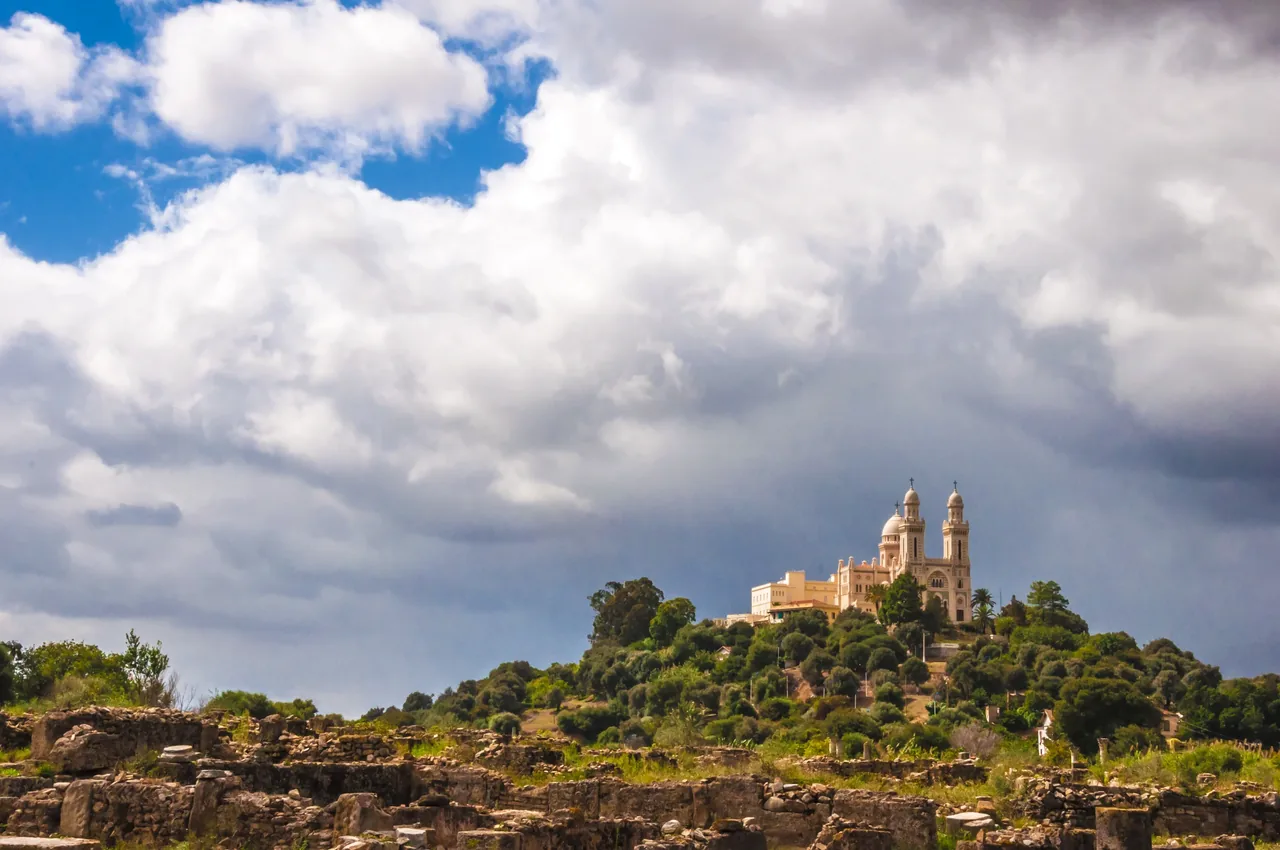
Basilica of Saint Augustine, Annaba
A living basilica above the ruins of Augustine's episcopal city, holding a relic of his arm and served by his own order.
- Location
- Annaba, Algeria 36.8811° N · 7.7469° E
- Type
- Catholic basilica and pro-cathedral Late nineteenth-century Roman-Byzantine basilica on the hill above the ruins of Hippo Regius
The bishop's own ground
Come because Augustine belongs here. The Confessions and The City of God were written in the city spread out below this hill, and the Church that reads him everywhere began as an African Church with its bishops, councils and martyrs. A pilgrim who has prayed at the Ark in Pavia has prayed at the tomb. Here he stands where the man lived, preached, argued, governed and died.
From Hippo Regius to the basilica on the hill
Hippo Regius was a Phoenician trading post, then a Numidian city allied to Carthage, then a Roman colony and a great grain port. Augustine was its bishop from 396 until 430, and he died here while the Vandals besieged the walls. The ancient Church of Roman Africa did not survive the centuries that followed, and it is honest to say so: there is no unbroken line of worship from Augustine's basilica to this one. What stands on the hill today was built in the late nineteenth century, in the colonial period, and the Church in Algeria does not pretend otherwise. What it does claim, rightly, is that Augustine is a son and a bishop of this soil, and that the small Catholic community of Algeria today keeps his memory where it began.
The basilica rises in the Roman-Byzantine manner favoured for North African churches in that period, set high enough to be seen from the city and the sea. The apse holds the reliquary. Below the hill lie the excavations of Hippo: forum, streets, baths, cisterns, mosaics, and the Christian remains that give the site its weight.
The basilica is the pro-cathedral of the Diocese of Constantine and Hippo.
The diocese states that custody of the shrine is entrusted to the Order of Saint Augustine.
Local people call the basilica Lalla Bouna, Our Lady of Hippo.
A full restoration between 2010 and 2013 allowed the centenary to be kept in 2014.
Pope Leo XIV came to Annaba during his April 2026 visit to Algeria and went down to the archaeological site of Hippo.
Augustine is not a Roman saint who happened to serve in Africa. He was born here, buried here, and this hill still carries his name.
This is a place of prayer before it is a monument. Mass is celebrated, the relic is venerated, and the Little Sisters of the Poor serve the elderly beside it. The diocese describes the hill simply: God is honoured here by prayer in the basilica and by the service of the poor.
Do Not Miss
-
The reliquary in the apse
A bone of Augustine's arm, given by Pavia, which holds his body. Pray here and at Pavia and the circle closes.
-
The Friday Mass
The Sunday liturgy of a Church that keeps the rhythm of the country it lives in.
-
The view down to Hippo
The excavated city below is the diocese Augustine actually governed.
-
The house of the Little Sisters of the Poor
The diocese names the service of the elderly here as part of how God is honoured on this hill.
- That the basilica is nineteenth-century and the city below it is Augustine's; the two are not the same Church continued
- That the shrine is kept by Augustine's own order
- That the community praying here is small, young and largely from elsewhere in Africa
- The local name Lalla Bouna, which is how the city itself speaks of the church
How to Visit
The diocese states that the basilica may be visited every day except Friday morning and Saturday, and that the Sunday liturgy is celebrated on Friday at 9.30, Friday being the day of rest in Algeria. Plan the visit around that Mass rather than around the monument, and join the ruins of Hippo to it in the same day. Confirm times with the basilica before travelling.
- Mass on the hill above the city Augustine served as bishop
- Prayer before the reliquary of Saint Augustine
- Intercession for the small Church of Algeria and for the people among whom it lives
- The works of mercy carried on beside the basilica by the Little Sisters of the Poor
The Sunday liturgy is celebrated on Friday.
Algeria keeps Friday as the day of rest, so the Sunday Mass at the basilica is celebrated on Friday morning. The diocese states that visits are possible every day except Friday morning and Saturday. Algeria requires a visa for most travellers and the Catholic community is small; write ahead rather than arriving unannounced.
- Mass
- The Sunday liturgy is celebrated Friday at 9.30 (diocesan information; confirm before travelling)
- Visiting
- Every day except Friday morning and Saturday, per the diocese
- Custody
- The Order of Saint Augustine
- Pair with
- The archaeological site of Hippo Regius, directly below the hill
Current access
Prayer and custody
Relics, Tombs, Sacred Objects
Tomb and Burial
- Augustine is not buried here. He died at Hippo in 430 during the Vandal siege; his body was carried to Sardinia and, around 720, to Pavia, where it rests in the Ark of Saint Augustine at San Pietro in Ciel d'Oro.
Relics and Sacred Tradition
- The basilica holds a bone of Augustine's right arm, given by Pavia in 1842 at the request of Bishop Dupuch and kept in a reliquary in the apse. Church sources in Algeria speak of the relic; the detailed account of its transfer comes from Algerian press and heritage sources rather than from a diocesan text.
Sacred Objects
- The reliquary of Saint Augustine in the apse
- The hill of Hippo itself, with the excavated city below
Connected Saints


Map
Hero image sourced from Wikimedia Commons (alioueche mokhtar, CC BY-SA 4.0). Sources: Eglise Catholique d'Algerie diocesan page (visiting and Mass information, Augustinian custody, restoration and centenary, Little Sisters of the Poor); Vatican News for the April 2026 papal visit to Hippo. The arm relic is attested in Algerian press and heritage sources rather than in the diocesan page, and is worded accordingly. Construction dates deliberately omitted: the diocese gives a 2014 centenary while general reference works give 1881-1900, and the discrepancy is unresolved.
September 17, 2026
Photo credits
- Hero. alioueche mokhtar, CC BY-SA 4.0, via Wikimedia Commons. Source. CC BY-SA 4.0.
- The basilica on the hill. Belhanizakaria, CC BY 4.0, via Wikimedia Commons. Source. CC BY 4.0.