
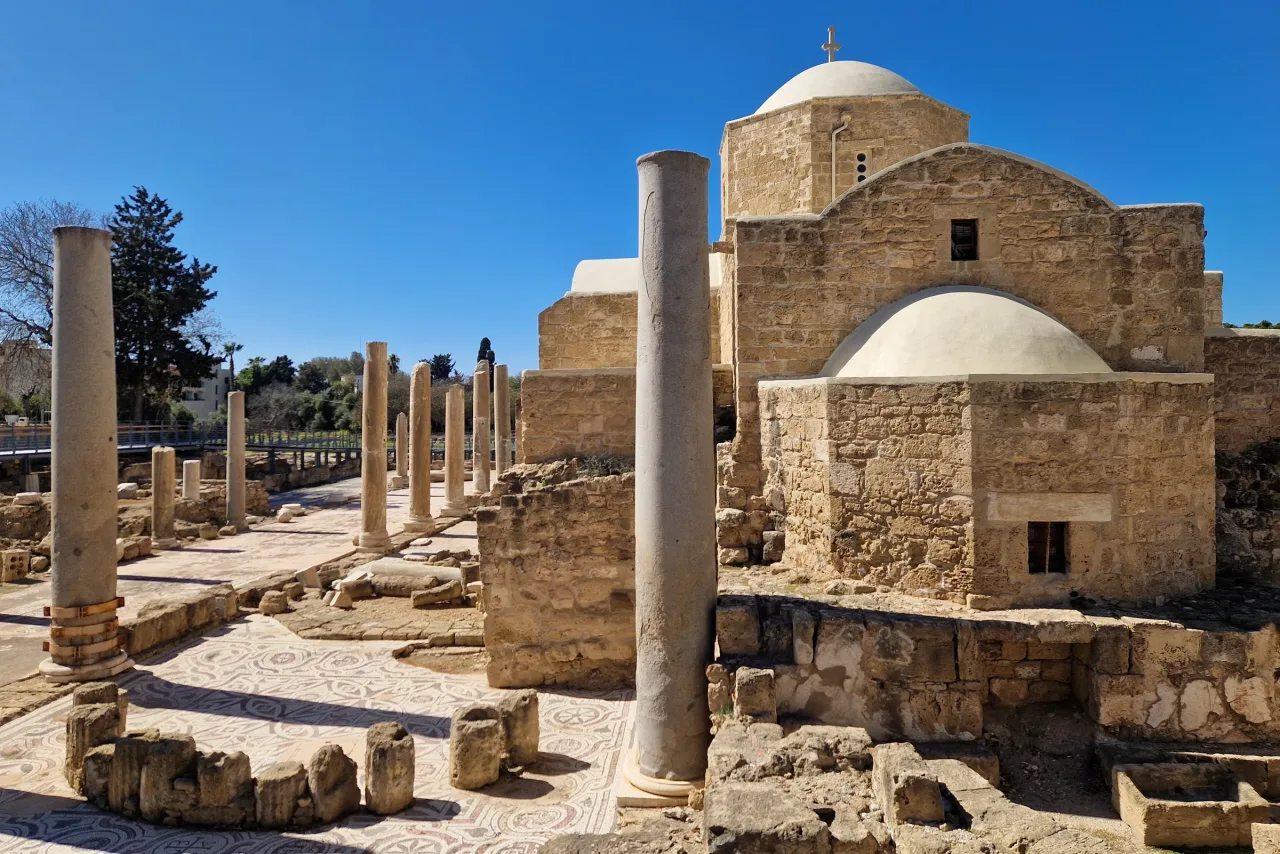
Agia Kyriaki Chrysopolitissa and St. Paul's Pillar, Paphos
A thirteenth-century church within the ruins of the largest Early Byzantine basilica on Cyprus, beside the object known as St. Paul's Pillar, and still a place of Christian worship.
- Location
- Paphos, Cyprus 34.7578° N · 32.4143° E
- Type
- Living church within an Early Christian archaeological complex A thirteenth-century church standing within the ruins of the largest Early Byzantine basilica on Cyprus
- Dedication
- Agia Kyriaki Chrysopolitissa
Why Go
Archaeology and liturgy in one place
Come here because you do not have to choose between archaeology and liturgy.
Several layers of Christian history remain visible together: New Testament Paphos, an Early Byzantine basilica, a medieval church, a later Pauline tradition, and worship that continues today.
Acts 13, the basilica, and the pillar
Acts 13:4-12 places Paul and Barnabas at Paphos and records the encounter with the proconsul Sergius Paulus and Elymas, also called Bar-Jesus. That is what Scripture establishes.
The present church of Agia Kyriaki Chrysopolitissa was built in the thirteenth century. It stands over and within the ruins of the largest Early Byzantine basilica on Cyprus, which was originally seven-aisled and later reduced to five. Mosaic pavements survive in the complex. The site also includes the object known as St. Paul's Pillar. Local tradition says Paul was flogged at the pillar before the conversion of Sergius Paulus. Acts does not say that Paul was flogged at Paphos or tied to this pillar, and the current church is not the church Paul entered.
The church remains a place of Christian worship. The Latin Catholic parish of Paphos, which belongs to the Latin Patriarchate of Jerusalem, celebrates regular Mass here. The Orthodox Bishopric of Paphos granted Catholic use of the church in the late twentieth century. Latin Catholics celebrate Mass here with the permission of the Orthodox Bishopric of Paphos. Orthodox services continue, and Anglican and other Christian communities also use the church on certain occasions.
A medieval church stands among the earlier basilica remains. Look for the surviving columns, the mosaic pavements, and the footprint of the vanished Early Byzantine basilica, which was seven-aisled and later reduced to five. St. Paul's Pillar is a devotional object of tradition, and it is not a witness to Acts.
Read the Place
How to pray at Paphos.
Begin with Acts, and keep the pillar in its place.
Acts 13:4-12
Read the account of Paul and Barnabas at Paphos, and give thanks for the preaching of the Gospel in Cyprus.
Tradition beside Scripture
The pillar tradition is later and local. Acts establishes Paul's presence at Paphos, and it does not establish the pillar. Venerate the tradition as a tradition.
Let the liturgy lead
If you attend Mass, let the living liturgy be the primary encounter. This is a church at prayer inside an archaeological site, and not only an attraction.
Spiritual Significance
Spiritual Significance
The contrast between archaeological remains and active worship is the point of the place. If you attend Mass, let the living liturgy be the primary encounter, not the ruins around it.
Do Not Miss
-
St. Paul's Pillar
Traditionally associated with Paul's flogging. Acts does not record that, so hold it as tradition.
-
The mosaic pavements
Surviving pavements within the archaeological complex.
-
Mass
Latin Catholic Mass is regularly celebrated here. Confirm the current schedule with the parish.
What to notice
- The medieval church standing among the earlier basilica remains.
- The surviving columns and the mosaic pavements.
- The footprint and scale of the vanished Early Byzantine basilica.
- St. Paul's Pillar as a devotional and traditional object.
- The contrast between archaeological remains and active worship.
How to Visit
How to Visit
Roman Catholic Mass is regularly celebrated at Agia Kyriaki. Consult St. Paul's Catholic Parish, or the Latin Patriarchate or the Cyprus Catholic Church, for the current schedule.
- Orthodox services continue
- Latin Catholic Mass is regularly celebrated by St. Paul's parish, with the permission of the Orthodox Bishopric of Paphos
- Anglican and other Christian communities use the church on certain occasions
Connected Saints
Map
Editorial sources
Visit Cyprus; St. Paul's Catholic Parish, Paphos; Latin Catholic Church of Cyprus; Latin Patriarchate of Jerusalem; Acts 13:4-12.
Official
Last reviewed
September 18, 2026
Photo credits
- Hero. Gerda Arendt / Wikimedia Commons (CC0). Source. CC0.
- The footprint of the earlier basilica. Viaggiamocela / Wikimedia Commons (CC BY-SA 4.0). Source. CC BY-SA 4.0.